A hoist can look suitable on paper and still be the wrong unit for the lift. The issue is rarely only rated capacity. In a proper lifting hoist review, the decision must account for the actual load path, frequency of use, available headroom, power supply, operating environment, and the documentation needed to place the equipment into service.
For vessel maintenance, port operations, fabrication yards, construction sites, and industrial plants, a hoist is part of a lifting system, not a stand-alone purchase. The chain or wire rope, hook, trolley, runway, suspension point, controls, and operator all affect whether the selected equipment performs safely and productively.
Start With the Actual Lift, Not the Catalog Rating
The working load limit of a hoist is the first filter, but it is not the complete answer. A 2-ton hoist should not automatically be selected simply because the heaviest item weighs 2 tons. The planned load may include lifting beams, clamps, slings, shackles, spreader bars, or below-the-hook attachments. Their combined weight reduces the available lifting capacity.
The load should also be assessed for its center of gravity, dimensions, and potential to shift during handling. Long machinery components, bundled cargo, pipe sections, and marine spares can introduce side loading or snagging forces that a straightforward vertical lift does not show. Hoists are designed for vertical lifting unless the manufacturer specifically states otherwise. Pulling at an angle, dragging a load, or using the hoist to tension cargo can damage equipment and create an uncontrolled lift.
Headroom deserves equal attention. In constrained engine rooms, workshops, ship holds, and offshore modules, the distance between the suspension point and the load may determine the hoist choice. A low-headroom trolley or compact hoist body may provide the necessary hook travel where a standard configuration cannot.
Manual, Electric, or Air Hoist?
The right drive type depends on use frequency, site services, and environmental conditions. Manual chain blocks remain a practical choice for intermittent lifts, remote locations, and maintenance tasks where portability matters. They are simple, dependable, and do not require electrical supply, but they are slower and place more demand on the operator during repeated lifts.
Electric chain hoists are often the better fit for regular workshop, warehouse, production, and vessel-repair work. They improve lift speed and control, particularly when paired with a motorized trolley. Their selection requires confirmation of voltage, phase, frequency, cable routing, pendant length, duty classification, and protection against moisture, dust, or corrosive exposure.
Air hoists are frequently specified in offshore, marine, and hazardous-duty applications where compressed air is already available or electric ignition sources must be controlled. They can offer high duty capability and fine control, though air quality, pressure, hose sizing, lubrication requirements, and noise levels must be considered before installation.
A useful question is not simply, “What hoist can lift this load?” It is, “What hoist can complete this lift repeatedly, under these site conditions, without creating avoidable delays or maintenance exposure?”
A Lifting Hoist Review Must Check Duty Cycle
Duty cycle is one of the most commonly overlooked selection factors. A hoist used a few times each month has a different requirement from one making repeated lifts throughout a shift. Heat buildup in the motor, brake wear, chain wear, and gearbox loading all increase with operating frequency and lift duration.
Review the expected number of starts per hour, average lift height, percentage of rated load, and total operating time. A unit used mainly for short, light lifts may not require the same duty classification as a hoist routinely handling near-capacity loads over full travel. Conversely, underspecifying a hoist for a busy maintenance bay or cargo-handling operation can lead to premature breakdowns and unplanned downtime.
Lift speed also involves trade-offs. Faster lifting can improve cycle time, but slow-speed control may be safer when positioning pumps, valves, machinery covers, or other high-value components. Variable-speed options can be justified where accurate placement is more important than maximum throughput.
Examine the Load Chain, Hook, and Brake System
A hoist should be inspected as an assembly. For chain hoists, confirm the load chain grade, size, length, finish, and compatibility with the operating environment. Corrosion-resistant protection may be necessary for wet or salt-air exposure, but coating alone does not replace proper inspection, cleaning, and lubrication.
For wire rope hoists, review rope construction, reeving arrangement, drum capacity, fleet angle, and the condition of sheaves and rope guides. Abrasion, crushing, broken wires, corrosion, and poor spooling can reduce safe service life well before the hoist appears visibly worn from a distance.
Hooks require close review because they are exposed to impact, side loading, and field modifications. Check for deformation, throat opening, cracks, latch condition, and clear working load limit identification. A safety latch helps retain a sling eye or shackle but is not a substitute for correct rigging practice.
The brake system must hold the rated load securely when controls are released. During acceptance testing and periodic inspection, verify that lifting and lowering response is controlled, limit switches function where fitted, and there is no abnormal slipping, chatter, or delayed braking. Any irregularity should remove the hoist from service until it is examined by a competent person.
Trolley, Beam, and Suspension Point Compatibility
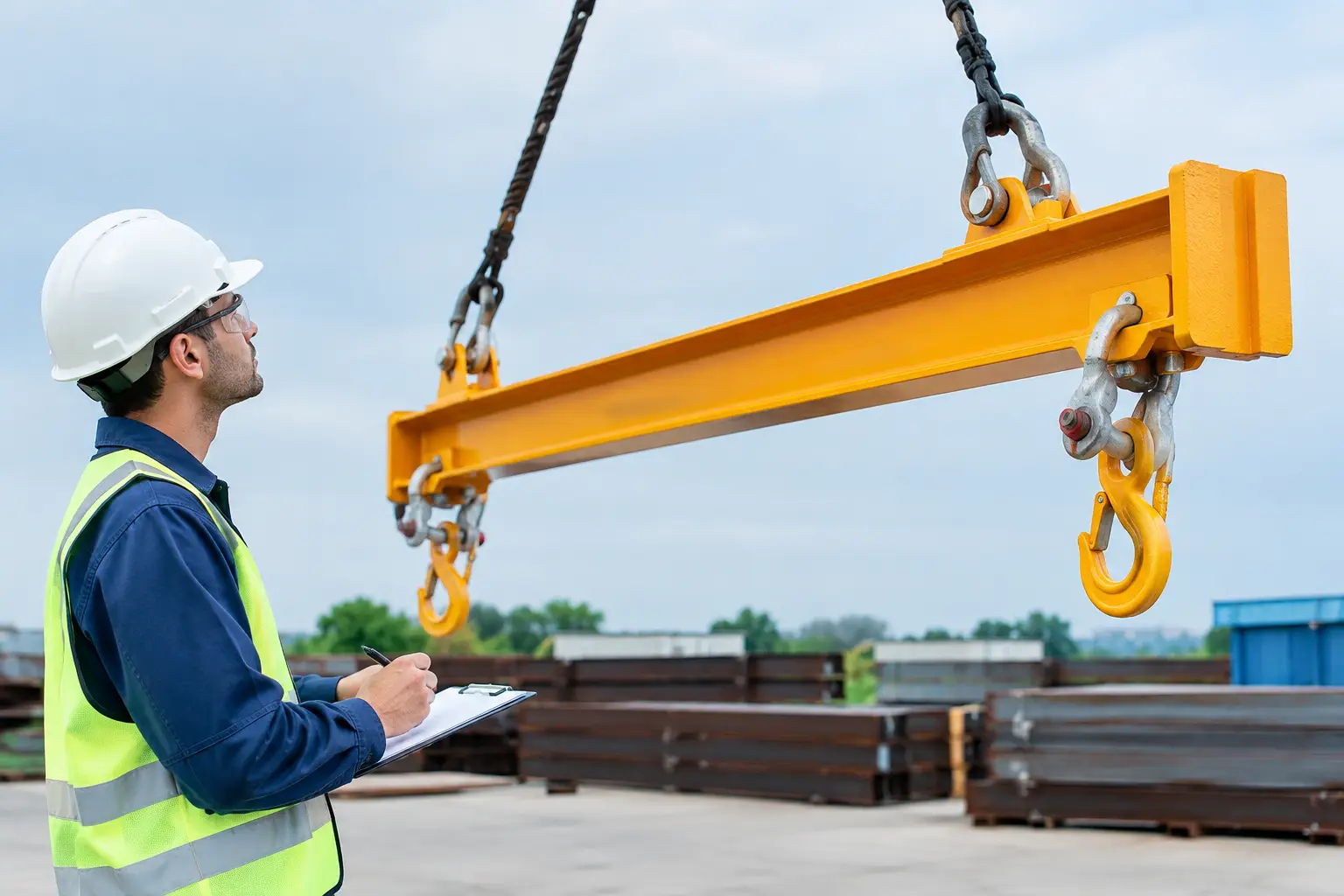
Many hoist problems start above the hoist itself. A trolley must match the beam flange width and profile, and the beam or runway must be verified for the intended load and dynamic forces. Improvised suspension from pipework, handrails, deck fittings, or structural members without engineering approval creates an unacceptable risk.
For temporary lifting arrangements, confirm how the hoist will be connected to the supporting structure. The shackle, beam clamp, lifting lug, padeye, or trolley must have adequate capacity and be compatible with the direction of loading. A high-capacity hoist cannot compensate for an unverified anchor point.
Travel requirements also matter. A push trolley may be adequate for occasional positioning, while a geared or motorized trolley can improve control on longer runs. Where the load needs to travel through a restricted area, assess clearance around the hoist body, pendant cable, hook block, and rigging before mobilization.
Documentation Is Part of Equipment Readiness
For safety-critical lifting equipment, certification and traceability are operational requirements, not paperwork added after delivery. Procurement teams should confirm the equipment identification, manufacturer details, rated capacity, test records, inspection status, operating instructions, and any documentation required by the project, vessel, class, client, or local authority.
New equipment may require proof-load testing or third-party certification depending on the application and governing requirements. Modified, repaired, or custom-configured lifting gear should be assessed and documented accordingly. When a hoist is supplied with a custom chain length, trolley, pendant arrangement, or lifting attachment, the final configuration should be clear in the equipment records.
This is particularly relevant when equipment moves between worksites or vessels. A hoist with incomplete records can be delayed at the gate, rejected during an audit, or removed from service during a planned shutdown. Full documentation gives lifting supervisors and safety teams a clearer basis for inspection and release.
Plan for Inspection, Service, and Urgent Replacement
A hoist selection should include the support needed after commissioning. Daily pre-use checks by the operator can identify obvious damage, chain twist, hook defects, control issues, and abnormal operation. Periodic thorough inspections should be scheduled according to usage, environment, manufacturer guidance, and applicable regulations.
Marine and offshore exposure usually shortens inspection intervals in practical terms. Salt contamination, humidity, vibration, and limited storage protection can accelerate deterioration. Equipment that remains idle on board still needs examination before it is returned to service.
When selecting a supplier, consider whether the equipment can be supplied job-ready, with the required chain length, trolley setup, load-test certification, and records. For specialized requirements, C&C International can support configured lifting equipment, testing, documentation, and technical coordination rather than supplying an unverified off-the-shelf unit.
The best hoist is the one that matches the lift, fits the supporting structure, performs at the required duty level, and arrives with records your team can rely on. Make those checks before the equipment reaches site, when there is still time to correct the specification rather than manage the consequences during a lift.