A broken wire beside a socket, a flattened section running over a sheave, or rust emerging from the rope core can turn a routine lift into an immediate safety decision. Wire rope inspection is not a paperwork exercise performed after the job. It is the control that confirms whether a lifting, towing, hoisting, or mooring line remains fit for the forces and conditions it will face.
For operations teams, the objective is clear: identify deterioration before it becomes a loss-of-load, snap-back, or equipment-damage event. That requires competent inspection, defined rejection criteria, and records that connect the rope to its certificate, installation details, and service history.
Wire Rope Inspection Starts With Rope Identity
An inspection has limited value if the inspector cannot confirm what rope is being examined. Before checking its physical condition, verify the rope diameter, construction, grade, lay direction, finish, length, end terminations, and rated capacity for the application. Confirm the identification tag or traceable reference against the relevant certificate and equipment register.
This matters especially when ropes have been cut to length, swaged, socketed, or installed as part of an assembly. A replacement rope that looks similar may have a different construction, minimum breaking force, or fatigue performance. For a multi-layer drum, crane hoist, winch, or marine towing arrangement, the specified rope design is part of the equipment system. Substitution without engineering review can create problems with fleet angle, sheave compatibility, crushing resistance, or spooling behavior.
The inspection should also establish the rope’s duty. A wire rope used for infrequent straight-line pulls will age differently from one working continuously over sheaves. Offshore exposure, seawater, abrasive cargo, heat, chemical contact, shock loading, and poor drum winding all change the inspection focus and the interval required.
What to Check During a Wire Rope Inspection
A competent visual and tactile examination should cover the full accessible length of the rope, not only the portion that is easiest to see. Particular attention is needed at termination points, around sheaves, at drum crossover zones, at points of repeated bending, and near areas exposed to splash, abrasion, or mechanical damage.
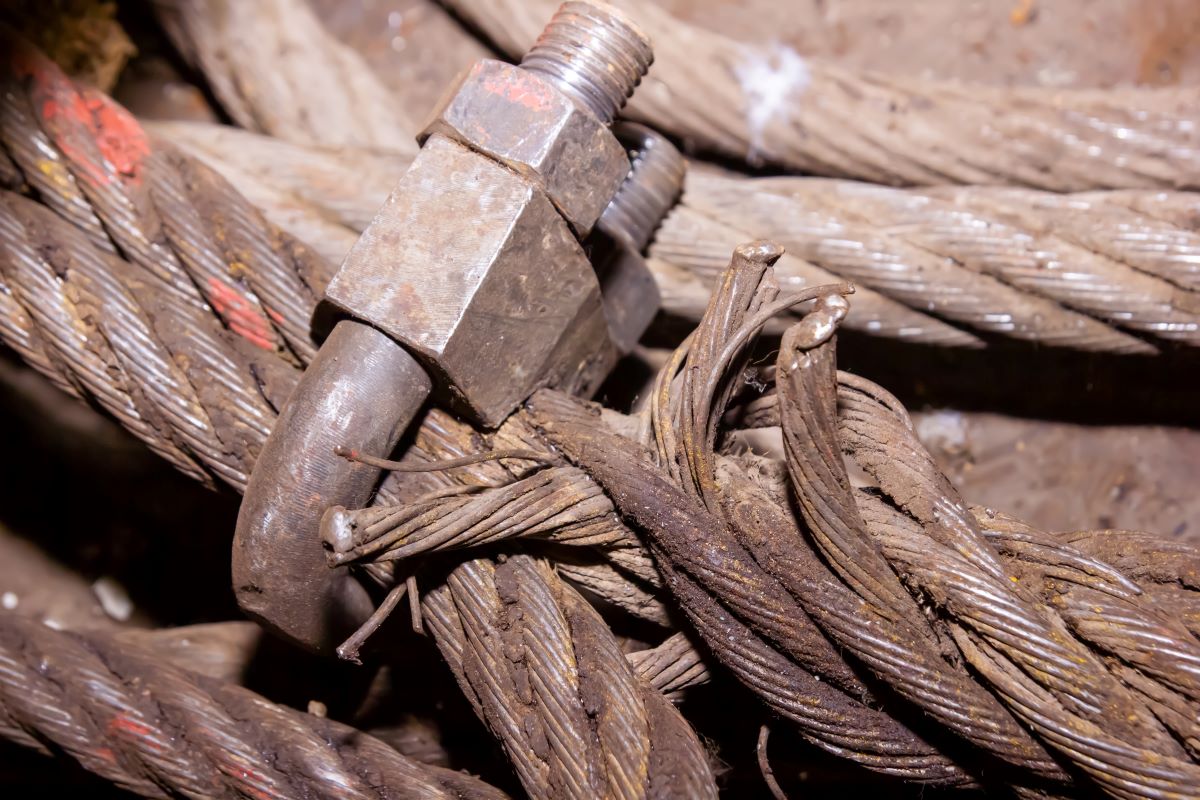
Broken wires are a primary indicator, but they should never be assessed in isolation. Record their number, concentration, location, and pattern. A few isolated breaks can indicate normal fatigue progression in some applications. A cluster of breaks, breaks at or near a termination, or breaks emerging from the valley between strands may signal more serious internal deterioration, distortion, or corrosion.
Look for reduction in diameter. Measure the rope at the correct points and compare the result with its nominal diameter and applicable acceptance criteria. A smaller diameter can result from core deterioration, wear, corrosion, or excessive loading. Localized diameter increase also demands attention because it may indicate a damaged core, birdcaging, or uneven strand movement.
Distortion is often easier to spot than to interpret. Kinks, flattened areas, crushed sections, waviness, protruding core, basket formation, and strand displacement can all reduce rope performance. A rope that has been shock loaded or allowed to jump a sheave groove may show damage that is not limited to the visible point of contact. Stop using the equipment until the rope path, sheaves, drum, and termination can be examined.
Corrosion requires a closer assessment than surface color alone. Light surface oxidation may be manageable when lubrication and protective maintenance are restored. Pitting, red dust, stiff rope behavior, or signs of corrosion at the core are different conditions. Internal corrosion can reduce metallic area without producing obvious external wire breaks. In marine service, pay close attention to portions of rope that remain wet, sit on drums for extended periods, or pass through splash zones.
Terminations deserve their own inspection. Check swaged sleeves for cracks, deformation, or slippage marks; inspect sockets for wire movement, cracks, and damage to the poured or wedge system; and verify thimbles, clips, shackles, pins, and connecting hardware are correctly fitted and free from deformation. A sound rope cannot compensate for an unsuitable or compromised termination.
Inspection Frequency Must Follow the Work
There is no single inspection interval that fits every rope. Daily or pre-use checks are appropriate for ropes supporting active lifting and personnel-risk work, while periodic documented examinations should be planned according to equipment type, service intensity, environment, manufacturer instructions, and applicable legal or client requirements.
The operator’s pre-use check is a practical condition check. It should identify visible damage, poor reeving, abnormal spooling, loose wires, damaged terminations, and changes since the previous shift. It does not replace a formal examination by a competent person.
The formal inspection should be more systematic. It records the rope condition, measurements, location of defects, termination status, lubrication condition, and any required corrective action. For high-cycle crane ropes, offshore lifting equipment, and critical winch applications, inspection planning should also consider non-destructive examination methods where they are justified by the risk and duty cycle.
Increase inspection frequency after an overload, snag, uncontrolled descent, shock event, drum overrun, exposure to fire or chemicals, or any incident that could have damaged the rope. Waiting for the next planned inspection after an abnormal event is a poor trade-off when the rope is part of a safety-critical system.
When a Rope Must Be Removed From Service
Removal criteria must follow the applicable standard, manufacturer guidance, equipment requirements, and site procedures. The inspector should not make a return-to-service decision based only on experience or appearance when specified criteria are available.
Immediate quarantine is generally the right response where there is evidence of a kink, birdcage, severe crushing, major diameter loss, broken strands, a damaged or slipping termination, heat damage, or substantial corrosion. The same applies when the rope’s identity, history, or capacity cannot be verified for its intended use.
There are cases where the decision is less obvious. Surface wear may be acceptable if measurements remain within limits and no associated damage is found. A limited number of broken wires may not automatically require retirement, depending on rope construction, location, and governing criteria. However, repeated local defects should be treated as a trend, not a series of separate minor findings. Deterioration accelerates once lubrication is lost, abrasion increases, or the rope begins to run poorly over damaged sheaves.
Do not attempt to straighten a kinked rope, hammer a distorted section back into shape, or conceal broken wires with tape, grease, or a protective wrap. These actions do not restore strength and can hide the condition from the next user. Clearly tag the rope or equipment out of service and control it until a qualified decision is made on replacement, repair where permitted, or disposal.
The Rope Path Is Part of the Inspection
Many premature rope failures begin with the equipment around the rope. A rope inspection should include sheaves, drum grooves, guards, equalizers, reeving, and anchorage points. Check for groove wear, sharp edges, seized sheaves, incorrect groove profile, misalignment, damaged lagging, and poor fleet angle.
On multi-layer drums, inspect for tight and even winding. Crossovers, loose wraps, and crushing between lower and upper layers can damage the rope internally. If the rope is consistently piling up on one side of the drum or rubbing against a flange, correct the underlying alignment or spooling issue before installing a replacement rope. Otherwise, the new rope will inherit the same failure mechanism.
Lubrication is another system issue. The rope needs a lubricant compatible with its original lubrication and service environment, applied in a way that allows penetration without creating a contamination hazard. Excessive grease can attract abrasive material, while no lubrication increases friction and corrosion risk. The right maintenance plan depends on the rope’s exposure and working cycle.
Documentation Makes Inspection Actionable
A useful record allows the next inspector to understand what changed and allows management to prove control of critical equipment. Record the date, equipment and rope identification, inspector, rope measurements, defect locations, findings, action taken, and release or quarantine status. Photographs are valuable for tracking localized wear and explaining a removal decision.
For new or replacement assemblies, retain the relevant test certificates, material traceability, swaging or socketing records, and any required PE-endorsed documentation. If the rope has been cut and swaged to specification, the finished assembly should be identified so it can be matched to its documentation in the field.
C&C International supports wire-rope supply, processing, load testing, and documentation for lifting and marine applications where traceability cannot be left to assumption. The practical benefit is a rope assembly configured for the equipment and delivered with records that support inspection and handover.
A wire rope rarely fails without warning, but warnings are only useful when someone has the authority and discipline to act on them. Build inspections around the actual duty, remove uncertainty quickly, and treat each recorded defect as information for the next safe decision.