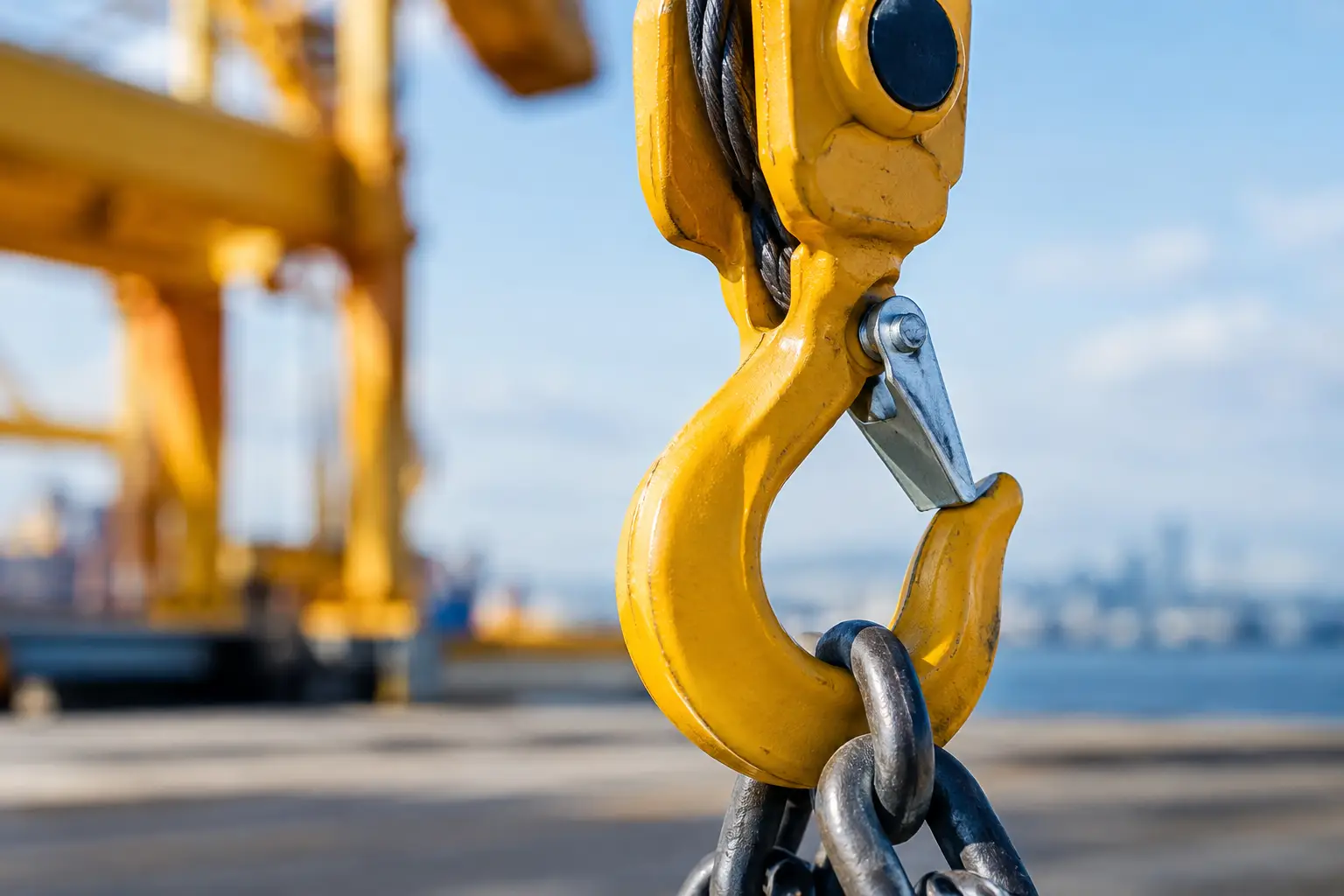
A shackle that looks clean on delivery can become the weak point of a lifting arrangement after months in salt spray, washdown water, or abrasive cargo work. The choice between galvanized versus stainless shackles is not simply a question of which finish resists rust better. It affects working load limit, inspection requirements, pin behavior, compatibility with connected components, and the documentation available for a safety-critical lift.
Galvanized Versus Stainless Shackles: Start With the Job
First define whether the shackle is for overhead lifting, lashing, towing, mooring support, general marine fastening, or a non-load-bearing installation. A shackle used in a certified lifting assembly must be selected by its marked working load limit, manufacturer specification, design standard, and traceable certification. Material appearance alone is never evidence that a shackle is suitable for lifting.
Galvanized shackles are generally carbon-steel shackles protected with a zinc coating, commonly hot-dip galvanized. They are widely used in marine, construction, cargo-securing, and general rigging applications because they provide practical corrosion resistance at a competitive cost. Many lifting-grade galvanized bow and dee shackles are available with clear working load limit markings and test certificates.
Stainless shackles are produced from corrosion-resistant stainless steel, often grades such as 304 or 316 for marine hardware. They are a common choice for architectural rigging, yacht and vessel fittings, exposed handrails, shade structures, and applications where appearance and resistance to surface staining matter. However, stainless steel hardware should not be assumed to match the strength, fatigue performance, or certified lifting rating of a forged galvanized shackle of the same nominal size.
The correct decision starts with the load path and the environment, then works back to material and configuration.
Corrosion Resistance in Real Service Conditions
Hot-dip galvanizing protects carbon steel in two ways. The zinc coating creates a barrier between the base steel and the environment, while zinc also provides sacrificial protection where minor scratches expose the underlying steel. This makes galvanized shackles a sound working choice for outdoor construction sites, ports, deck equipment, and general seawater exposure where regular inspection and replacement are part of the maintenance plan.
The coating is not permanent. Chain contact, wire rope movement, grit, impact, and repeated pin handling can wear it away. Once corrosion begins at damaged areas, loss of section can accelerate if the shackle remains in a wet, salt-contaminated condition. Galvanized hardware should be cleaned, inspected, and replaced when corrosion, pitting, deformation, or coating loss affects serviceability.
Stainless steel does not rely on a sacrificial coating. Its corrosion resistance comes from a passive oxide layer that reforms when exposed to oxygen. In many wet and weather-exposed installations, this gives stainless hardware a long service life and a cleaner appearance than galvanized steel.
That benefit has limits. Chloride-rich conditions can cause pitting and crevice corrosion, particularly where saltwater is trapped beneath a pin shoulder, inside a threaded connection, or between tightly assembled components. Stainless hardware installed permanently on vessels, near splash zones, or in poorly drained locations still requires washdown and inspection. Grade 316 generally offers better chloride resistance than 304, but neither grade removes the need for a maintenance program.
For continuously immersed, highly chlorinated, or chemically aggressive service, consult the hardware manufacturer and project specification rather than relying on the label “marine grade.” The surrounding materials, water temperature, oxygen availability, and cleaning regime all matter.
Strength, Working Load Limit, and Certification
For lifting operations, the central question is not galvanized or stainless. It is whether the specific shackle is purpose-designed, marked, and certified for the intended load and method of use.
A forged, lifting-grade galvanized shackle may carry a defined working load limit and be supplied with proof-test certification and traceable identification. This is often the practical choice for lifting slings, spreader arrangements, pad eyes, lifting beams, and rigging assemblies exposed to outdoor or marine conditions. Select bow shackles where multiple sling legs or wider connections need room to articulate, and dee shackles where an in-line connection is required. The geometry must suit the load path.
Many stainless shackles are made for general-purpose marine fastening rather than overhead lifting. Their dimensions may resemble lifting shackles, but resemblance is not a rating. Some have no working load limit, no batch traceability, and no proof-test documentation. Others may be load-rated for a specific application but have restrictions on side loading, pin type, or dynamic service.
Do not substitute an unmarked stainless shackle for a certified lifting shackle because it appears corrosion resistant. If stainless is required for a rated lifting application, confirm the working load limit, applicable standard, material grade, proof-load requirements, and certification before purchase.
Side loading deserves particular attention. A shackle is strongest when loaded in line through the bow and pin as designed. Sling angle, connection width, and multiple-leg loading can introduce side load or pin rotation that reduces capacity. Follow the manufacturer’s reduction guidance. Do not make field assumptions based on a shackle’s diameter or the capacity of the sling connected to it.
Pin Type Changes How the Shackle Performs
Material selection must be paired with the correct pin arrangement. A screw pin shackle is convenient for temporary connections, frequent assembly, and applications where the pin can be inspected regularly. It can loosen under vibration, movement, or rotation if not properly managed. It is not always suitable for permanent or dynamically loaded arrangements.
Bolt-type shackles use a bolt, nut, and retaining cotter pin. They are generally better suited to long-term installations, vibration-prone connections, and critical rigging arrangements where pin retention is required. The exact application remains subject to the manufacturer’s instructions and the site lifting plan.
Stainless threaded pins can gall, especially when dry threads are tightened aggressively or repeatedly exposed to contamination. Galling can lock a pin before it reaches the intended seating position or make later removal difficult. Keep threads clean, use an approved anti-seize compound where permitted, and avoid forcing a binding pin. Cross-threading and improvised tools create defects that are easy to miss during a rushed mobilization.
Compatibility Is Part of Corrosion Control
A shackle rarely works alone. It connects to sling eyes, chain links, pad eyes, wire rope sockets, turnbuckles, hooks, and lifting lugs. The hardness, diameter, shape, and material of each contact point affect both wear and corrosion behavior.
When stainless steel is connected directly to galvanized or carbon-steel components in a wet environment, galvanic corrosion can increase on the less noble metal. The risk rises when dissimilar metals remain electrically connected and regularly wet with saltwater. Isolation washers, sleeves, protective coatings, and drainage may be appropriate in fixed installations, but they must not interfere with the load path or reduce the shackle’s seating area.
Check fit as carefully as material. A pin that bears on a sharp lug edge, a bow crowded by a sling eye, or a shackle used over a connection that is too wide can produce localized loading and premature damage. Avoid placing multiple loose components on a pin unless the manufacturer permits that arrangement.
A Practical Selection Process
For procurement and field teams, a disciplined review prevents material preference from overriding engineering requirements. Confirm these points before issuing or installing shackles:
- The intended use is lifting, lashing, mooring, towing, or general fastening.
- The required working load limit accounts for sling angles, dynamic effects, and any manufacturer reductions.
- The shackle shape, size, and pin type fit the connected equipment without side loading or point loading.
- The material and finish suit the actual exposure, including salt spray, standing water, chemicals, abrasion, and cleaning practices.
- Markings, certificates, inspection records, and project documentation meet the applicable requirement.
For planned lifting work, specify the shackle alongside the full assembly rather than ordering it as an isolated item. This allows the supplier to verify clearances, connection types, and certification needs before equipment reaches the site. For urgent vessel or offshore requirements, provide photographs, dimensions, working load limit, connection details, and the intended service. Those details reduce the risk of receiving hardware that fits physically but is unsuitable for the job.
Inspection and Replacement Decisions
Both galvanized and stainless shackles need routine pre-use inspection. Remove a shackle from service if it shows bent or distorted body geometry, stretched bow, worn pin, damaged threads, cracks, unreadable markings, unauthorized weld repairs, or corrosion that may affect strength. Do not straighten, heat, weld, or machine a lifting shackle in the field unless an approved manufacturer process specifically allows it.
For galvanized shackles, watch for extensive zinc loss, red rust, and deep pitting around the pin and crown. For stainless shackles, inspect closely for staining, pitting, crevice corrosion, seized threads, and cracking around highly stressed sections. A bright stainless surface is not proof of sound condition, just as a dull galvanized finish is not automatically a reason for rejection.
Where certification, load testing, or custom rigging configuration is required, C&C International can support supply with documentation and project-specific technical processing. The best shackle choice is the one that arrives matched to the load, environment, connection geometry, and inspection regime – not simply the one that looks most corrosion resistant on the shelf.