TL;DR
For a top-over ratchet tie down, the number that does the work is STF, the pre-tension it puts into the strap, not the LC printed in large type; LC only governs direct and diagonal lashing.
EN 12195-1 turns friction, lashing angle, STF and the road or sea acceleration factors into a lashing count, so a 2.4 tonne crate on plywood can need three straps where many crews would fit one.
Most buyers order a ratchet tie down by width and the biggest label number, then fit as many as look sensible. EN 12195 works the other way round: Part 2 defines each figure on the label, and Part 1 turns those figures, deck friction and expected accelerations into a lashing count you can defend. Below, we read the label, separate frictional from direct lashing, and work a road and sea calculation for a load leaving Jurong or Tuas.
What Do LC, STF and SHF on an EN 12195-2 Label Actually Mean?
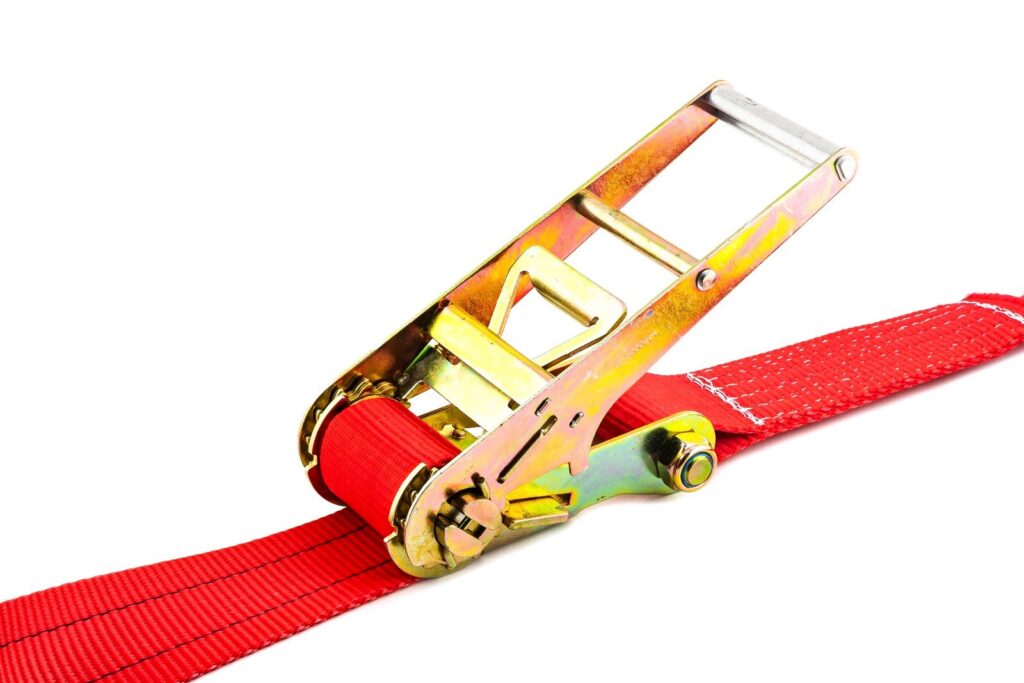
LC is the maximum straight-pull force, STF is the residual strap tension after ratcheting with a standard hand force, and SHF is that hand force, 50 daN. Under EN 12195-2, STF is defined as the force remaining “after physical release of the handle” following an SHF of 50 daN, so two straps with identical LC can have very different STF values. 1 daN is 10 N, roughly 1 kg of force. Our polyester webbing belt lashing to EN 12195-2 follows this format.
| Label field | What it tells you | What to check |
|---|---|---|
| LC (daN) | Lashing capacity in straight pull; used for direct and diagonal lashing | Stated in daN, not “5T” |
| STF (daN) | Pre-tension achieved at 50 daN hand force; used for top-over lashing | Printed on the label, not left blank |
| SHF (daN) | Standard hand force, 50 daN | Should read 50 daN |
| Label colour | Webbing material: blue PES, green PA, brown PP | Blue for a polyester lashing belt |
| Other fields | Length, maker, traceability code, “not for lifting” | Legible, matches paperwork |
A typical EN 12195-2 lashing instruction sheet states a factor of 2 on the complete system and fittings, 3 on the webbing, and elongation under LC below 7 percent. That factor of 2 is why a strap sold as “5,000 kg” is usually quoting breaking force; the LC is half.
Frictional or Diagonal Lashing: Which Method Does Your Ratchet Strap Use?
A ratchet strap over the top of the load is a frictional lashing: it presses the cargo onto the deck, so its effect depends on STF and the vertical angle. A strap run from the load to an anchor point, as in a diagonal lashing, is a direct lashing that holds the cargo through its own LC.
In EN 12195-1:2010 the safety factor fs is 1.1 sideways and rearward and 1.25 forward, and for direct lashing the friction factor μ is multiplied by fμ = 0.75. A diagonal lashing is usually more efficient for heavy loads on low-friction decks, because LC works against movement directly.
Which Acceleration Coefficients Apply on Road and at Sea?
On road, EN 12195-1 uses 0.8 g forward, 0.5 g rearward and sideways, and 1.0 g vertical. For vehicles carried by sea it sets values by sea area: area A 0.3 longitudinal and 0.5 transverse, area B 0.3 and 0.7, area C 0.4 and 0.8. A trailer running between a Jurong warehouse and a Tuas yard uses road values; the same load on a regional ro-ro voyage must be checked for the route’s sea area.
How Do You Calculate How Many Tie Down Straps a Load Needs?
For top-over lashing against sliding, EN 12195-1:2010 gives n = ((c − μ·cz) × m × g) ÷ (2 × μ × sin α × STF) × fs, rounded up, where c is the horizontal coefficient. The formula and constants reproduce the worked crate example in the International Guidelines on Safe Load Securing for Road Transport, where two lashings at 55° hold 10.9 tonnes sideways but only 1.4 tonnes forward.
Worked example: a 2,400 kg crated skid, sawn wood on plywood (μ 0.45, as in that guide), tie down straps with STF 400 daN at 80°.
| Case | c | μ | fs | Result | Straps |
|---|---|---|---|---|---|
| Road, sideways | 0.5 | 0.45 | 1.1 | 0.37 | 1 |
| Road, forward | 0.8 | 0.45 | 1.25 | 2.91 | 3 |
| Road, forward, rubber mat | 0.8 | 0.6 | 1.25 | 1.25 | 2 |
| Sea area C, sideways | 0.8 | 0.45 | 1.1 | 2.56 | 3 |
Forward governs: three straps on a bare deck, two with anti-slip mats (μ 0.6 per the European best practice guidelines). A headboard or forward diagonal lashing often replaces extra top-over straps. For heavy duty cargo straps used top-over, STF and friction matter more than LC.
When Must a Lashing Belt Be Discarded?
Withdraw a lashing belt when the webbing shows tears, cuts or wear in the load-bearing fibres, when hooks or the ratchet are deformed or cracked, or after knotting or unprotected sharp-edge contact, per the EN 12195-2 guidance summarised by Sicurezza del Carico. With the label missing or unreadable, LC and STF cannot be verified, so treat the strap as unrated. The European Best Practice Guidelines on Cargo Securing put it bluntly: “Severely damaged webbing? Throw it in the waste basket!”
Can a Ratchet Tie Down Be Used as a Lifting Sling?
No. A lashing works to a factor of 2, a webbing sling to EN 1492-1 to a factor of 7, and label colour means material on a lashing but WLL on a sling. Under Singapore’s WSH regime, lifting gear must be marked and examined for lifting; a lashing never is. Store them apart.
What Are the Procurement Red Flags on Heavy Duty Cargo Straps?
The European Commission notes that inadequate cargo securing is a factor in up to 25% of accidents involving trucks. Reject any strap whose label shows tonnes instead of daN, has no STF, cites no EN 12195-2 reference, or has no traceability code. Ask for the test certificate and check the hook type, such as the J hooks on our DJ hook ratchet lashing, against your anchor points. For the wider system, see our best cargo lashing practices guide.
Frequently Asked Questions
Is LC or STF more important for a ratchet tie down?
For top-over lashing, STF. LC matters for direct and diagonal lashing.
Why does my ratchet strap say 5,000 kg but LC 2,500 daN?
The larger figure is usually breaking force; with a system factor of 2, LC is half.
What friction factor should I use?
The EN 12195-1 Annex B value for the surfaces in contact, such as 0.45 for sawn wood on plywood.
Do sea voyages need more tie down straps?
Often: sideways acceleration rises from 0.5 to 0.8 in sea area C.
Can a lashing belt lift a load?
Never. Lashings are marked “not for lifting”.
Specify the Strap the Calculation Asks For
A ratchet tie down is only as good as its label and the maths behind how many you fit. Read the STF, respect friction, check the sea area. C&C International Trading supplies the full cargo securing range to Singapore’s port, shipyard and logistics operators. Talk to our team about your next load.