
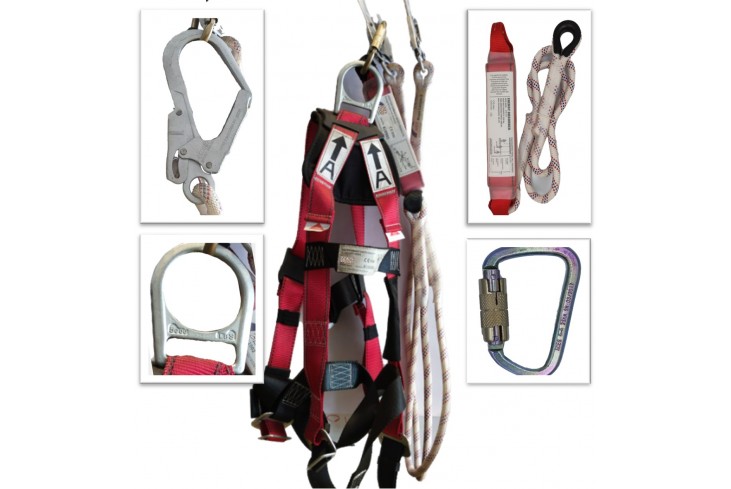
1. EN361:2002 | Full Body Harness
This is the primary requirement for a harness designed for fall arrest. Unlike sit harnesses or waist belts, a full body harness is designed to distribute fall forces across the shoulders, chest, and thighs.
Key Requirement: Must have designated fall-arrest attachment points (usually marked with an ‘A’) located on the dorsal (back) or sternal (chest) position.
Safety Function: Ensures the body remains upright after a fall to prevent suspension trauma.
2. EN354:2010 | Lanyards
This standard governs the physical tether (rope, webbing, or cable) that connects the harness to the anchor point.
Key Requirement: The total length of the lanyard, including connectors and terminations, must not exceed 2 meters.
Important Note: An EN354 lanyard on its own is often just a “restraint” device. To be used for fall arrest, it must be used in conjunction with an EN355 energy absorber.
3. EN355:2002 | Energy Absorbers
This is perhaps the most critical component for safety. In a fall, the kinetic energy generated can be lethal to the human body if stopped instantly.
Function: Uses a “tear-webbing” design to deploy and absorb the energy, limiting the impact force to less than 6kN.
Calculated Clearance: When these deploy, they extend the length of the fall. You must account for the “deployment distance” when calculating your safety height.
4. EN362:2004 | Connectors
This covers the carabiners, scaffold hooks, and snap-hooks used to link the system together.
Key Requirement: Connectors must have a self-closing and self-locking or manual-locking gate.
Strength: They are tested for “Major Axis” strength, typically requiring a minimum breaking strength of 20kN or higher.