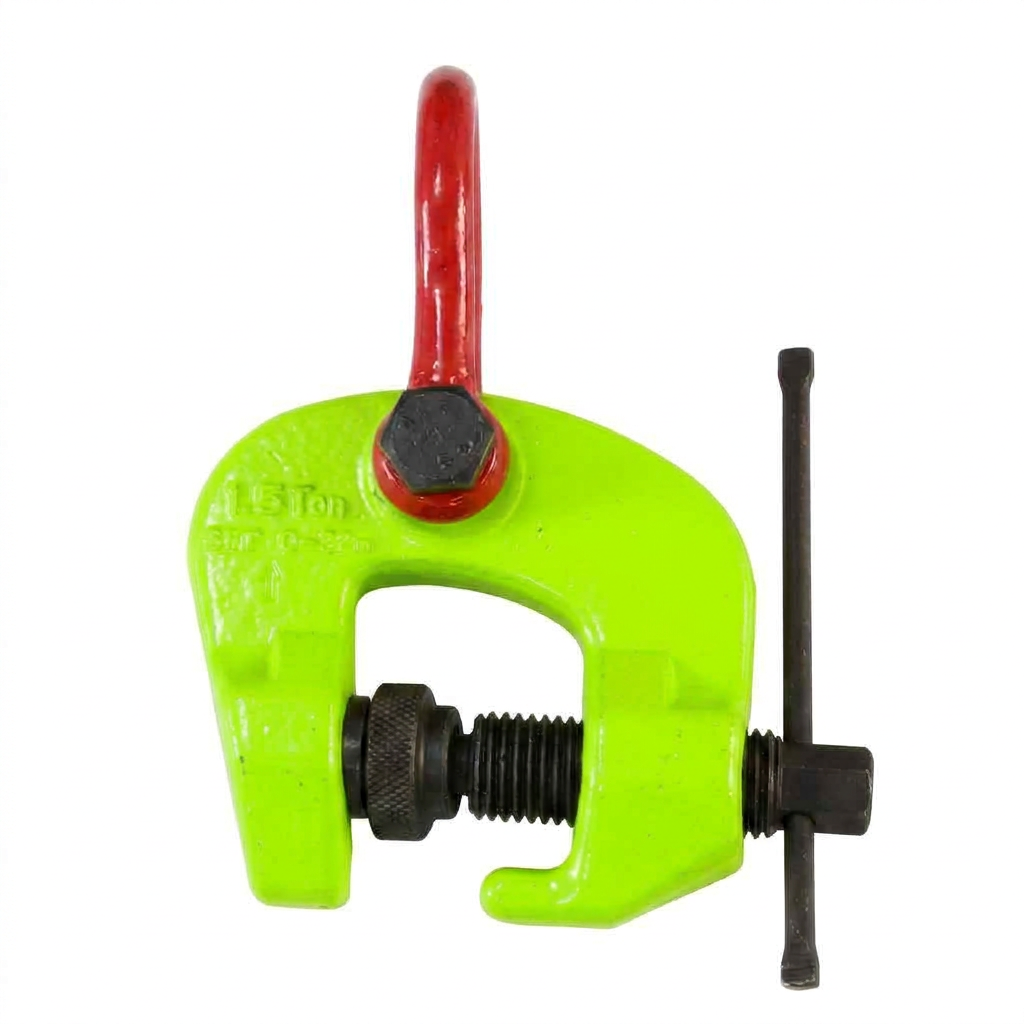
Key Features and Mechanism
The SCC clamp is engineered for versatility and safety in heavy-duty environments like shipbuilding, construction, and steel working.
- Universal Spherical Cam: Equipped with a swiveling spherical surface type cam that allows for a reliable grip on complex shapes, such as curved or spherical plates.
- Self-Tightening Load Action: When a load is applied, the cam tilts in proportion to the weight, causing the teeth to bite deeper and increase clamping force.
- No Minimum Load Requirement: Unlike standard cam clamps that may require a minimum load to engage, the SCC’s screw mechanism provides a positive grip regardless of the weight, making it safer for light or shifting loads.
- Omni-Directional Shackle: Features an articulated lifting eye or shackle that allows the clamp to be loaded from any angle (360-degree rotation) without losing effectiveness.
- Durable Construction: Typically made from die-forged special alloy steel with heat treatment and a baked-on finish for maximum strength and durability.
Common Specifications
- Capacity Range: Standard models range from 0.3 tons up to 6 tons.
- Jaw Openings: Generally accommodate steel plates from 0mm to 75mm thick, though some wide-type models (e.g., SCC-W) can handle up to 100mm.
- Torque Requirements: For safe operation, initial screw tightening should typically be over 35 N·mfor larger models (1–6 tons) and 5 N·m for 0.5-ton models.
Standard Capacity and Jaw Openings
The following sizes are commonly available from major manufacturers like Super Tool, Tiger Lifting, and H-Lift. Note that “W” in a model name typically indicates a “Wide” jaw range.
Common configurations include:
| Capacity (Tons) | Standard Jaw Opening (mm) | Wide Jaw Opening (mm) |
| 0.3 / 0.5 | 0 – 28 | 50 – 100 |
| 1.0 / 1.5 | 0 – 32 | 50 – 100 |
| 3.0 | 0 – 50 | 25 – 75 |
| 6.0 | 0 – 75 | — |
Note on Torque: For safe operation, smaller clamps (0.5t) require a minimum tightening torque of 5 N·m, while larger models (1t–6t) require at least 35 N·m.
Safety and Maintenance
- Two-Point Lifting: For maximum safety, it is recommended to lift loads using at least two clamps in a balanced configuration.
- Replaceable Parts: The cam and pad are designed to be easily replaced when teeth become worn or clogged.
- Hardness Limits: These clamps are generally suitable for steel with a maximum hardness of approximately 37 HRC.
- Visual Checks: Many models include check marks or phosphorescent paint on the cam to help operators confirm the cam’s position during use.