Usage Guidelines
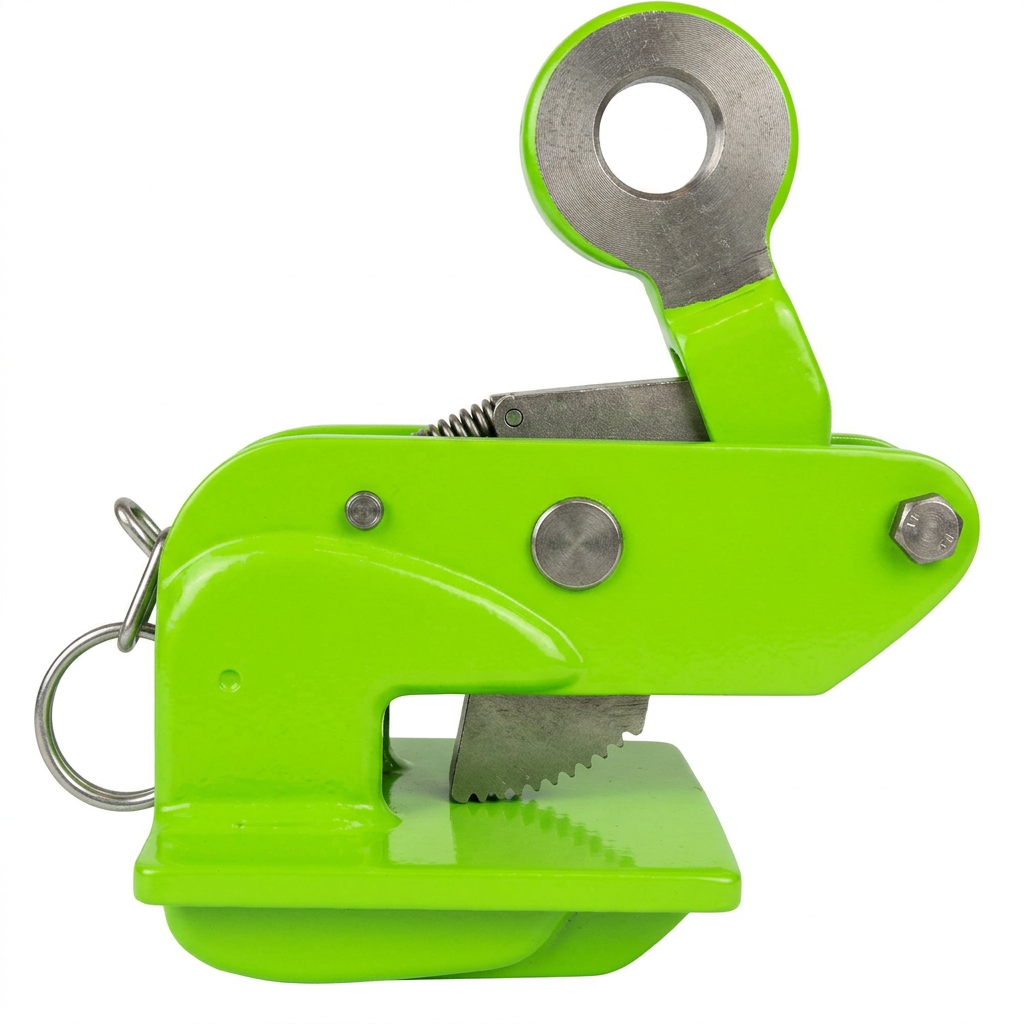
Using these clamps requires careful preparation to ensure the load is balanced and the mechanism is fully engaged.
- Initial Setup: Position the clamps evenly along the edge of the plate, ensuring they are placed over the center of gravity.
- Full Engagement: Insert the load into the innermost end of the jaw opening(the “neck”) before tightening.
- Lock Engagement: Before lifting, ensure the safety lock is completely engagedto provide an initial clamping force.
- Pairing: Always use at least two clamps. For long plates that may sag, use two or more pairs in conjunction with a spreader beam.
- Lifting: Apply tension slowly and smoothly to allow the jaws to bite; avoid sudden jolts or shock loading.
Critical Safety Precautions
Failure to follow these precautions can lead to load slippage or equipment failure.
- Never Lift Single-Point: Do not attempt to lift a load using only one clamp.
- No Multi-Plate Lifting: These clamps are generally intended for lifting one plate at a time; do not lift stacks of plates unless specifically approved.
- Angle Limits: The lifting angle between the sling legs should typically not exceed 60 degrees(some manufacturers specify 30 or 45 degrees); exceeding these angles significantly reduces the clamp’s Rated Capacity.
- Surface Condition: Ensure the load surface is free of oil, paint, scale, or rust, as these can cause the gripping pad to slip.
- Hardness Limits: Do not use on materials with a surface hardness exceeding approximately 37 RC (345 HB)unless the clamp is specifically designed for high-hardness materials.
- Personnel Safety: Never lift loads over people and ensure all personnel remain clear of the supported plate.
Common Sizes and Specifications
Clamps are categorized by their Working Load Limit (WLL) and jaw opening range.
| Capacity (Metric Tons) | Jaw Opening (mm) | Typical Application |
| 0.5 Ton | 0 – 20 mm | Thin sheets and light plates |
| 1.0 Ton | 0 – 25 mm | Standard steel plates |
| 2.0 Tons | 0 – 30 mm | Medium-duty plates and beams |
| 3.0 Tons | 0 – 38 mm | Heavy industrial plates |
| 5.0 Tons | 0 – 40 mm | Large-scale construction steel |
| 8.0 – 10.0 Tons | 20 – 70 mm | Heavy-duty girders and thick slabs |