web analytics

Products

Cable Sock

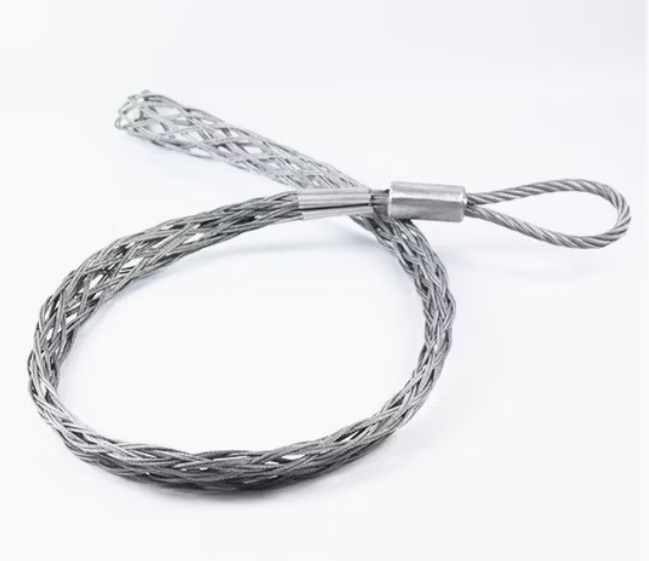
Cable socks (also known as cable pulling grips, stockings, or “Chinese fingers”) are specialized flexible mesh sleeves used to pull, support, or replace wire ropes and electrical cables. They operate on the “friction-grip” principle: as tension is applied, the woven mesh body tightens around the cable, distributing the pulling force evenly along its length.

Specifications

Common Models and Types

Cable socks are categorized by their attachment points and how they are fitted onto the cable:

  • Single Eye (Type S/Type R): The most common type, featuring a single pulling loop at one end. It is used for standard pulls where the end of the cable is accessible.
  • Double Eye (Type D/Type RA): Features two loops at one end, providing more stable load distribution and allowing the cable to pass entirely through the grip. This is ideal for supporting vertical cables at intermediate points.
  • Lace-Up (Type L/Split Mesh): An open-sided mesh that is wrapped around the cable and “laced” together like a shoe. These are essential when the cable end is already connected or inaccessible.
  • Open Ended (Type O/Type RB): Both ends are open, allowing the sock to be used as a joiner between two cables (e.g., when replacing an old wire rope with a new one).
  • Offset Eye: The pulling eye is set to one side of the mesh, allowing the cable to pass through the end of the grip. This is useful for pulling through tight conduits or manholes.

Specifications and Materials

Feature Details
Diameter RangeStandard sizes typically cover 6mm to 110mm+.
MaterialGalvanized Steel (standard), 316 Stainless Steel (corrosive/marine), or Aramid/Kevlar (non-conductive).
Weave DensitySingle weave for light duty; Double or Triple weave for heavy-duty transmission lines and high-tension pulls.
Breaking LoadCan range from a few hundred kilograms to over 30,000 kg for high-strength models.

Limitations and Safety Factors

  • Not for Permanent Lifting: Cable socks are designed for temporary pulling or support during installation; they are not intended as permanent lifting devices.
  • Safety Factors:
    • 3:1or 5:1 is typically recommended for standard pulling.
    • 10:1may be required for high-risk operations.
  • Torsional Stress: If a wire rope or cable has a natural “lay” (twist), it can cause the sock to untwist and lose its grip. A line pulling swivel must be used to release this torque.
  • Sizing Sensitivity: A sock that is too large will slip, while one that is too small can damage the cable jacket. Always measure the actual outer diameter (OD) of the cable, not its nominal size.
  • Inspection: Socks must be retired immediately if they show broken wiresstretched mesh, or heavy corrosion.