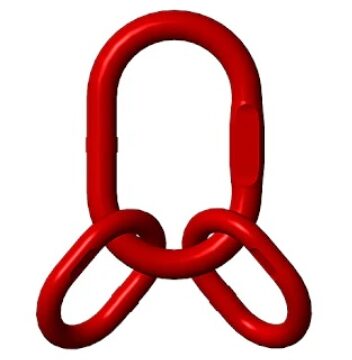
Usage of Masterlink Assemblies
Connection Points: They act as the primary connection point between lifting machinery (cranes, hoists) and the load.
Sling Assembly: They are used to gather multiple chain or wire rope legs, particularly in 3- and 4-leg slings.
Sub-Assemblies: For 3- and 4-leg slings, sub-assemblies (a main link with two intermediate links) are used to prevent crowding and ensure proper load distribution.
Compatibility: They must fit properly into the crane hook, and intermediate links must be sized correctly for the chain or wire rope, ensuring they fit freely without binding.
Angular Loading: When using multi-leg slings, the master link must be chosen to account for reduced capacity due to the angle of the legs.
Safety Precautions
Never Overload: Exceeding the Working Load Limit (WLL) causes yielding, leading to permanent deformation (elongation, narrowing) and reduced structural integrity.
Inspection Before Use: Perform a visual inspection before every lift to check for cracks, deformation, wear, or corrosion.
Retirement Criteria: Immediately remove from service if the link shows >10% wear, any signs of cracks, severe corrosion, or if the hook diameter is reduced.
Do Not Repair: Never attempt to weld, repair, or heat treat a damaged master link.
Proper Fit: Ensure the link fits properly in the hook; it should not be “point loaded” (hanging on the tip of the hook).
Identify Markings: Ensure the link has legible, permanent markings for WLL, grade, and manufacturer, as required by standards like ASME B30.26.
Avoid Environmental Damage: Protect from excessive heat (which softens steel) and corrosive substances, which can cause hydrogen embrittlement.
Key Operational Precautions
Side Loading: Avoid side-loading the master link; it is designed for vertical axial load.
Sharp Edges: Use padding to protect the assembly from sharp corners on the load.
Balanced Load: Ensure the lift is balanced and the center of gravity is considered to avoid sudden shifts.
Free Movement: The master link must move freely in the crane hook.
No Personnel: Never use master links to transport people.
Temperature Ranges: Standard alloy steel (Gr 80/100) works best between -20°C to 200°C (-4°F to 400°F).
Inspection and Maintenance
Frequent Inspection: A visual check for damage, wear, or distortion before each use or shift.
Periodic Inspection: A detailed, documented inspection by a competent person (often annually or more frequently for severe service).
Lubrication: Regularly lubricate any moving parts (e.g., in specialized swivel assemblies).
Storage: Store in a clean, dry, and cool area to prevent corrosion and damage.
Properly chosen and maintained, master links are essential for safe, reliable lifting, ensuring compliance with OSHA and ASME standards.
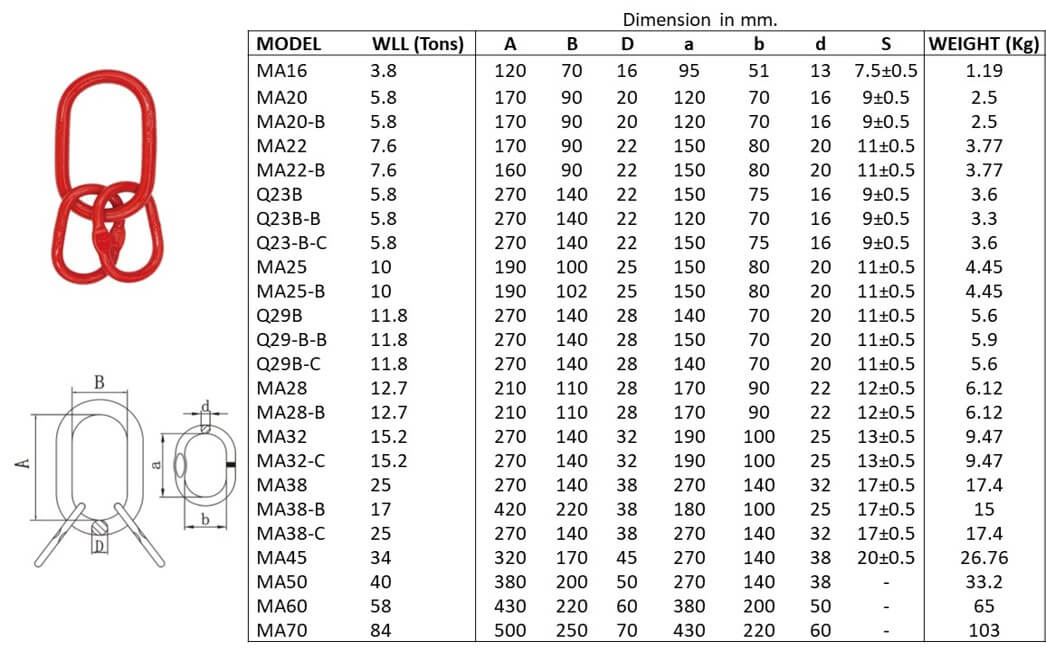
Common Sizes & Specifications: