
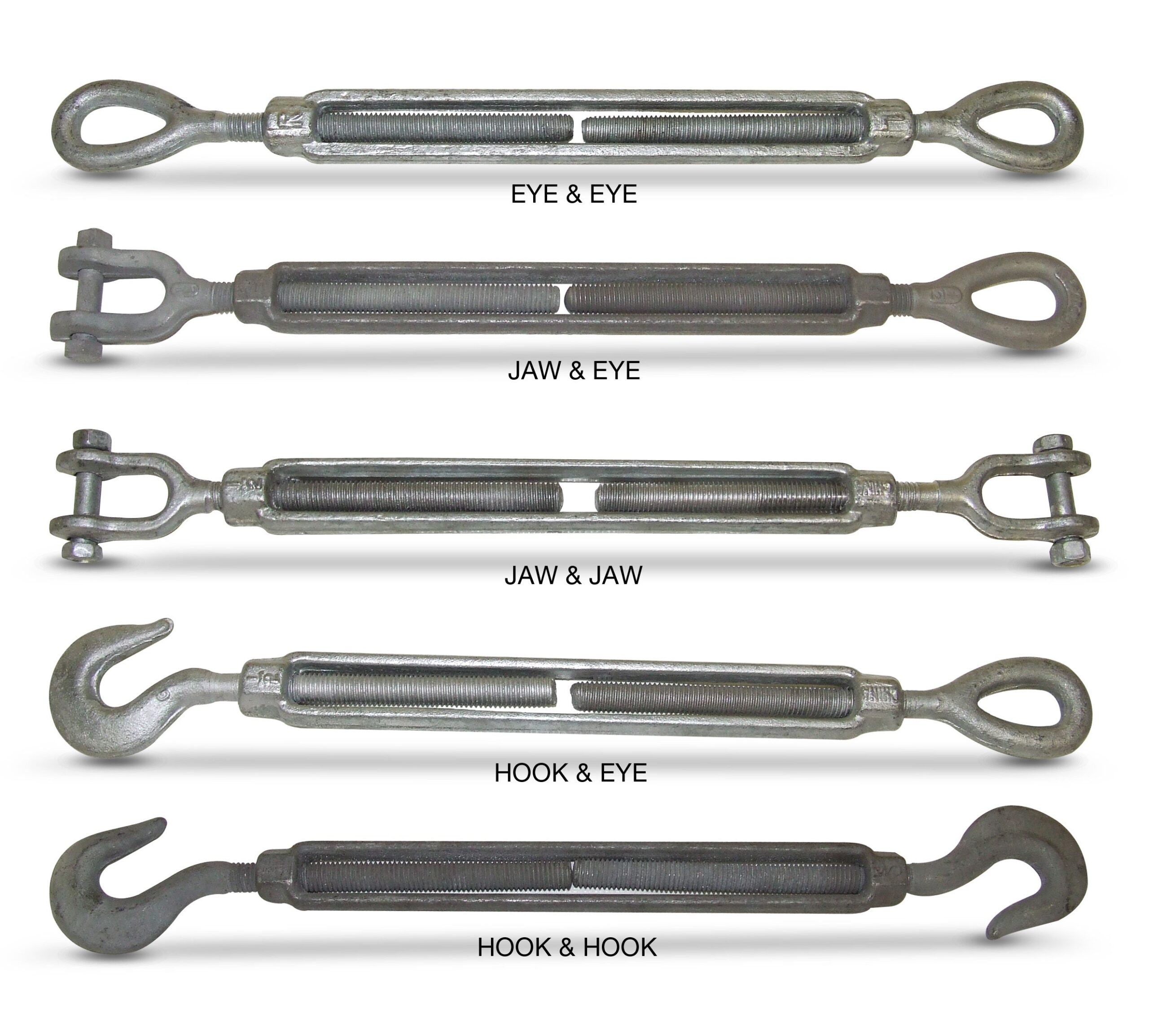
A turnbuckle is a piece of hardware used to eliminate slack and adjust tension in a rope, cable, or other tensioning system.
ASME B30.26 – Rigging Hardware defines a turnbuckle as “an adjustable device consisting of three primary components: a body, a right-hand threaded end fitting, and a left-hand threaded end fitting.”
The end fitting on either side of a turnbuckle connects to the tensioning system and/or a securement point. The turnbuckle is then tightened or loosened to adjust tension and eliminate slack in the cable or rope is it connected to.
A turnbuckle may be used on its own or in conjunction with other turnbuckles to increase length in the assembly.
End Fittings: these are the two connection points that screw into the opposite ends of the turnbuckle body. One end fitting is right-hand threaded while the other is left-hand threaded. This allows you to turn the body to adjust tension after installation without moving the end fittings.
There are three main types of end fittings that can be used together in any combination on either end of the turnbuckle:
Thread diameter: this is the diameter measurement of the threaded portion of the end fittings. The greater the thread diameter is, the greater the load-bearing capacity of the turnbuckle and vice versa.
Take-up length: this is the total length that the end fittings can screw into and out of the body to “take up” tension. Take-up length can be measured in terms of “opened” or “closed” end fittings: the end fittings are either fully extended or fully retracted.
Turnbuckle types are, essentially, named for the combination of end fittings used in the device. The most common end fitting combinations are:
As mentioned above, turnbuckles can be used with a length of rope, cable, or other rigging assembly as a connection point to adjust slack and tension within the line.
Turnbuckles can be used for something as simple as a fence or as complicated as a suspension bridge. Some industries that commonly use turnbuckles are:
The most common turnbuckle materials are galvanized and stainless steel. Choosing between these two materials is important if factors like price and corrosion resistance are important to you.
Stainless steel turnbuckles are ideal for use in outdoor and saltwater environments, as they are extremely resistant to rust and corrosion. If corrosion is a concern, stainless steel is likely the best choice for your turnbuckle material.
Galvanized/ drop forged steel turnbuckles are cheaper than stainless steel and can also be used in outdoor applications, but with caution, as they are not as resistant to corrosion as stainless steel turnbuckles.
During the course of a turnbuckle inspection, remove it from service if any of the conditions listed in ASME B30.26 – Rigging Hardware are present:
We stock and distribute turnbuckles in a variety of different configurations and sizes in both galvanized, drop forged and stainless steel. We can supply both daily use models as well as premium ones from Crosby.
If you require further advice on selecting the most suitable turnbuckle for your needs, please contact one of our Lifting Specialists today.