Technical Breakdown
- 6: The number of main outer strands that are twisted around the central core.
- WS (Warrington-Seale): The specific internal configuration of wires within each strand.
- Warrington: Uses two different wire sizes in the inner layer to maximize steel density.
- Seale: Uses thick outer wires to provide superior abrasion and crush resistance.
- 31: The number of individual wires in each of the 6 strands.
- IWRC (Independent Wire Rope Core): The central core is itself a smaller wire rope made of steel rather than fiber.
- Benefits: Provides higher tensile strength, better resistance to crushing, and superior heat resistance compared to fiber cores (FC).
Key Performance Characteristics
- Flexibility: With 31 wires per strand, this rope is more flexible than the standard 6×19 class, allowing it to bend smoothly around pulleys and sheaves.
- Load Capacity: It typically achieves a superior breaking load compared to 6×19 constructions.
- Durability: The Warrington-Seale design balances the flexibility of thin inner wires with the durability of thick outer wires for long-term industrial use.
Common Applications
According to manufacturers, this construction is standard for:
- Heavy Lifting: Crane hoists, tower cranes, and mobile crane operations.
- Marine & Offshore: Ship mooring, towing lines, and offshore drilling platforms.
- Industrial Engineering: General hoisting systems, elevators, and winch lines.
- Mining: Mine shaft hoists and shovel operations.
Specifications
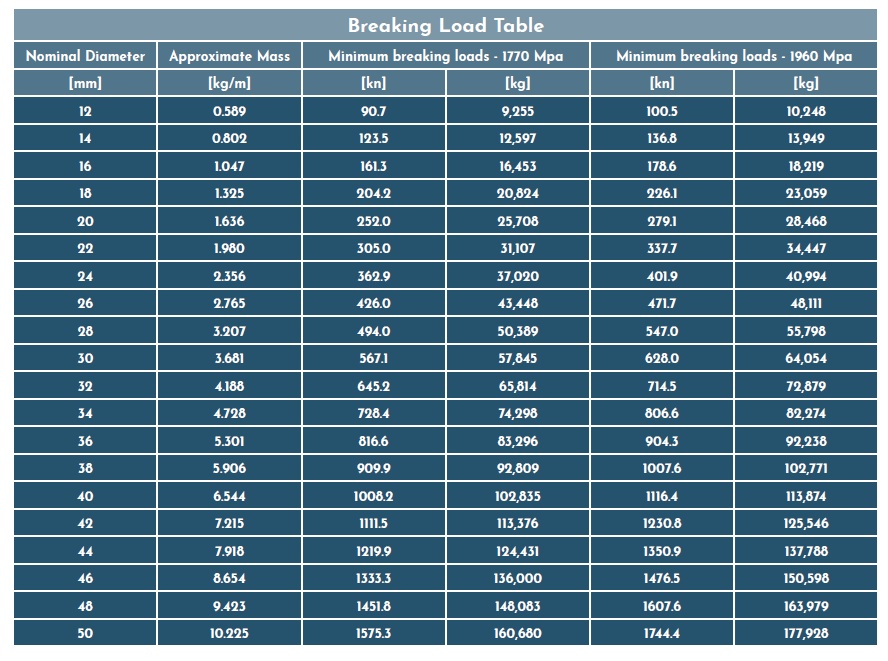
Precautions for 6X (WS) 31 IWRC wire rope focus on its susceptibility to internal damage, strict rotation limits, and maintenance of its structural integrity. Because of its complex Warrington-Seale (WS) construction, this rope requires specialized handling to ensure the 186 individual wires (6 strands x 31 wires) remain properly aligned.
Critical Operational Precautions
- Do Not Use with Swivels: This construction is not rotation-resistant. Attaching it to a swivel will cause the rope to unlay (untwist), leading to a dangerous loss of strength and potential catastrophic failure.
- Maintain Sheave Ratios: To prevent premature fatigue from repeated bending, ensure sheaves and drums have a diameter at least 20 times the rope’s nominal diameter.
- Control Fleet Angles: Keep the fleet angle between 1° and 1.5°to prevent the rope from rubbing against itself or the drum flanges, which causes severe abrasion.
- Avoid Shock Loading: Abruptly applying or releasing a load can cause permanent structural damage like bird caging(strands bulging out) or kinking.

