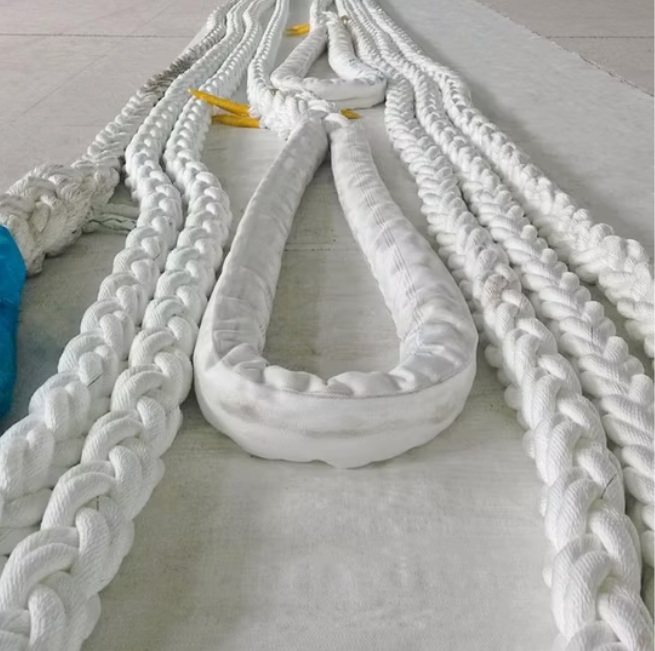
Predominantly 2 types:
-
Mixed Rope Mooring Tails (Composite)
These are typically a blend of High Tenacity Polypropylene and Polyester. They are currently the industry standard for many commercial vessels.
- Uses: General mooring for tankers, bulkers, and container ships. Ideal for use with HMPE (High Modulus Polyethylene) main lines.
- Pros:
- Balance: Offers better elasticity than wire but is stiffer than nylon, providing controlled movement.
- Durability: High resistance to abrasion and UV degradation compared to pure polypropylene.
- Handling: Usually stays flexible even after getting wet or used heavily.
- Buoyancy: Many mixed ropes are designed to float or be neutrally buoyant.
- Cons:
- Lower energy absorption compared to 100% nylon.
- Can suffer from “internal friction” heat if cycled too rapidly under extreme loads.
-
100% Nylon (Polyamide) Mooring Tails
Nylon is the “classic” high-stretch option, known for its immense energy-gathering capabilities.
- Uses: High-energy environments where significant surge or heavy swells are expected. Often used in exposed berths.
- Pros:
- Maximum Stretch: Can stretch up to 20-30% before breaking, which significantly reduces peak loads on deck hardware.
- Strength: Very high breaking strength relative to its diameter.
- Cons:
- Wet Strength Loss: Nylon loses roughly 10-15% of its strength when wet.
- Snap-back: Because it stores so much energy, a nylon tail failure is extremely dangerous due to high-velocity snap-back.
- Internal Melting: Repeated heavy cycling can cause the core to melt from internal friction (hysteresis).
Comparison Table
| Feature |
Mixed Rope (Composite) |
100% Nylon (Polyamide) |
| Elasticity |
Moderate (Excellent for HMPE) |
Very High (Best for shock) |
| Wet Strength |
No loss |
10-15% loss |
| Service Life |
Longer (better abrasion resistance) |
Shorter (fatigue-prone) |
| UV Resistance |
Excellent |
Good |
| Safety |
Lower snap-back energy |
High snap-back risk |
Precautions & Maintenance
- The 22-Meter Rule: While 11-meter tails are standard, 22-meter tails are increasingly recommended for ships using HMPE lines to ensure enough elongation is present to handle environmental surges.
- OCIMF MEG4 Compliance: Ensure any tail purchased meets the Oil Companies International Marine Forum (OCIMF) Mooring Equipment Guidelines. This ensures the tail’s “Ship Design Minimum Breaking Load” (SDMBL) is matched correctly to your vessel.
- Inspection: Check for “fusing” (hard, melted spots) on nylon tails. For mixed ropes, look for pulled strands or excessive fuzzing (chafing).
- Connection: Always use a shackle or a “Boss” link to connect the tail to the main line. Never tie them together with a knot, as this reduces strength by 50%.
How to Order
To get an accurate quote from us, you should provide the following specifications:
- Material: “Mixed Polyolefin/Polyester” or “100% Nylon”
- Construction: e.g., 8-strand plaited or 12-strand braided
- Length: Standard is 11m or 22m (measured from inside eye to inside eye).
- Diameter/MBL: State the required Minimum Breaking Load (MBL). It should typically be 25-30% higher than the MBL of the main mooring line it is attached to.
- Eye Termination: Standard 2-meter covered eyes on both ends are typical. Specify if you need leather or polyester cloth chafe protection in the eyes.
- Certification: Request Class Certificates (ABS, DNV, or Lloyd’s) and confirm MEG4 compliance.