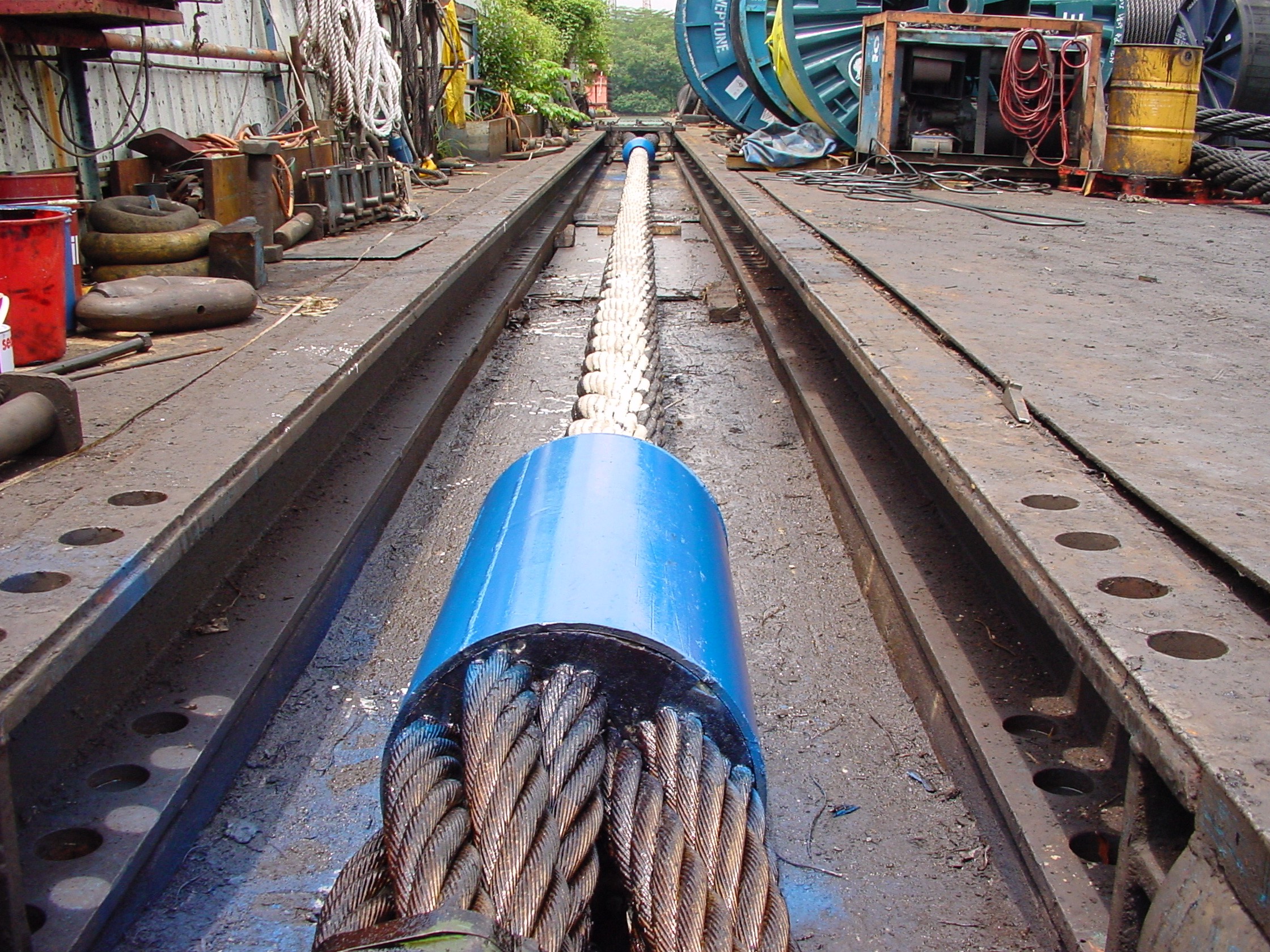
Non-Destructive Testing (NDT) for lifting gears—such as shackles, hooks, and chains—is a critical safety requirement to identify fatigue and structural flaws that visual inspections might miss. In Singapore, these inspections must often be conducted by an Authorised Examiner (AE) or an accredited laboratory to meet Ministry of Manpower (MOM) standards.
Common NDT Methods for Lifting Gear
| Method |
Application |
Best For… |
| Magnetic Particle Inspection (MPI) |
Shackles, hooks, links, and welds on lifting beams. |
Detecting surface and near-surface cracks in ferromagnetic materials. |
| Dye Penetrant Testing (DPT/PT) |
Non-magnetic components or stainless steel gear. |
Finding surface-breaking defects like fine cracks or porosity. |
| Ultrasonic Testing (UT) |
Thick sections of lifting beams or large-diameter pins. |
Identifying internal flaws or measuring material thickness loss due to corrosion. |
| Eddy Current Testing (ET) |
Eyebolts and fast screening of bolts. |
Detecting surface and subsurface indications without removing paint/coatings. |
| Visual Testing (VT) |
All gears before and after NDT. |
Identifying deformation, wear, and corrosion. |
Safety Factors & Load Testing
NDT is typically used alongside Load Testing to ensure the gear can handle its rated capacity.
- Safety Factors (Design): While NDT doesn’t change the safety factor, it verifies the material integrity required to maintain it. Common safety factors for gear include 4:1 to 7:1 (e.g., wire ropes are often 5:1 or 6:1).
- Proof/Overload Testing: New or repaired gear is often tested at 125% of its Safe Working Load (SWL).
- SWL Marking: All gear must be clearly marked with its maximum SWL. If too small for markings, a colour-coded system or labels must be used.
Regulatory & Statutory Considerations
- Inspection Frequency: In Singapore, lifting gears must be thoroughly examined by an AE at least once every 12 months (or every 6 months for equipment lifting personnel).
- Accreditation: NDT for statutory equipment must be performed by a laboratory accredited by the Singapore Accreditation Council (SAC) under the SAC-SINGLAS scheme.
- Broken Wire Limits: For wire ropes, the number of visible broken wires in any length of 10 diameters must not exceed 5% of the total wires.
- Documentation: Owners must retain certificates of test and examination for verification by MOM inspectors.
Key Safety Principles
- Pre-use Inspection:A competent person should visually check gear before every lifting operation for signs of elongation or cracks.
- Stop-Work Authority:All personnel are empowered to stop a lift if the gear appears damaged or the operation becomes unsafe.
A pre-use visual inspection is your first line of defence. It should be performed by a Competent Person (e.g., a trained rigger or operator) before every shift or lifting operation.
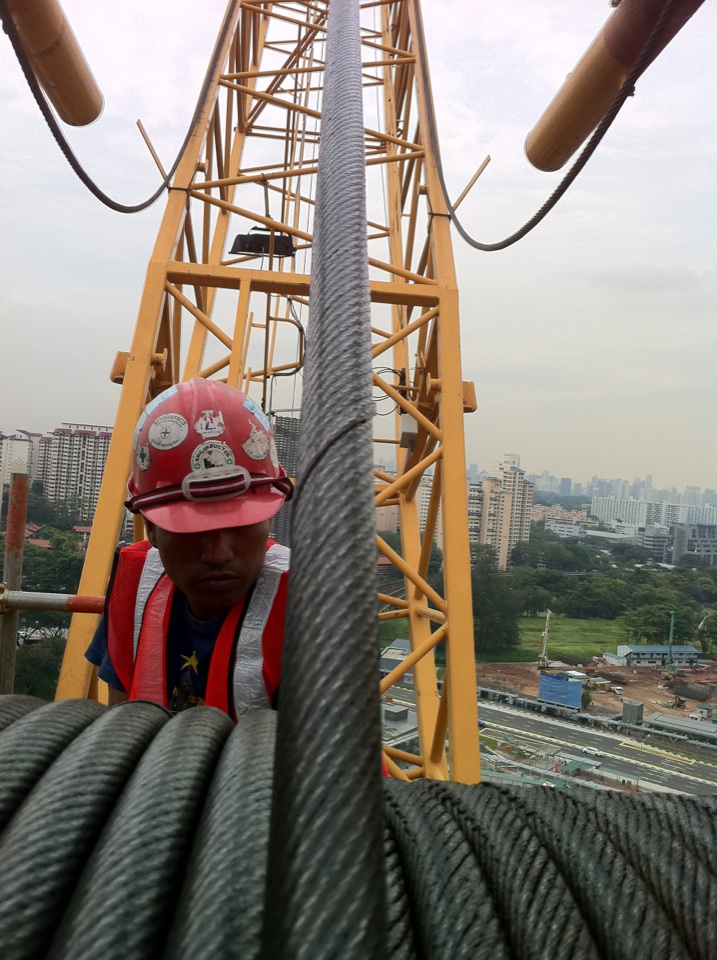 Wire Rope Sling Checklist
- Identification Tag: Ensure the tag is present and legible, showing the manufacturer, Safe Working Load (SWL), and diameter.
- Broken Wires: Check for visible breaks. Removal criteria typically include:
- 10 randomly distributed broken wires in one rope lay.
- 5 broken wires in one single strand in one rope lay.
- Structure Distortion: Look for kinks, bird caging (strands opening up), crushing, or core protrusion.
- Corrosion: Check for severe rusting or pitting that affects wire flexibility or diameter.
- Heat Damage: Look for metallic discoloration (blue/straw) or weld spatter.
- End Fittings: Inspect ferrules and eyes for cracks, deformation, or evidence of slipping.
Shackle Checklist (Bow & D-Shackles)
- Markings: Verify that the body and pin have matching manufacturer marks and SWL ratings.
- Body & Pin Condition: Inspect for any bending, twisting, or stretching. If the shackle is worn more than 10% from its original dimensions, it must be scrapped.
- Pin Engagement: Ensure the pin is straight and can be fully seated by hand. Check that threads are clean and not stripped.
- Cracks & Nicks: Search for surface-breaking cracks, especially at the “crown” (the bend) and around the pin holes.
- Unauthorized Repairs:Check for signs of field welding or the use of non-original pins (e.g., using a bolt instead of the manufacturer’s pin).
General Site “Red Flags”
- Colour Coding: Confirm the gear has the current periodic inspection colour code (e.g., the current month/quarter colour used at your site).
- Cleanliness: If the gear is covered in thick grease or mud, clean it with a rag to ensure defects aren’t hidden.
- “If in doubt, throw it out”: Never use gear that looks suspicious. Tag it as “DEFECTIVE” and remove it from the work area immediately to prevent accidental use.
Safety Tip: When checking wire ropes, always wear gloves. Running a bare hand along a rope with broken wires can cause serious puncture injuries.
When a piece of lifting gear fails either a visual inspection or a formal NDT test, you must follow a strict “Quarantine and Dispose” protocol to ensure it never makes its way back into a lifting operation.
Here is the step-by-step process for handling failed gear:
- Immediate Withdrawal (The “Red Tag” Rule)
- Stop Work:Immediately cease using the item.
- Physical Segregation:Remove the gear from the work area. If it stays on the floor, someone else might use it by mistake.
- Tagging:Attach a highly visible “OUT OF SERVICE” or “DO NOT USE” In Singapore, many sites use a Red Tag system to signal failure.
- Quarantine:Place the item in a locked scrap bin or a designated “Quarantine Area” that is physically separated from “Live” equipment.
- Formal Recording
- Inspection Log:Record the failure in your Lifting Gear Register. Note the serial number, the nature of the defect (e.g., “cracked crown on shackle”), and the date.
- Report to AE:If the failure occurred during a statutory inspection, the Authorised Examiner (AE) will issue a report stating the equipment is unfit for use.
- Permanent Decommissioning (Destroying the Gear)
Simply throwing a defective sling in the bin isn’t enough—scavengers or unaware workers might pull it out. You must render the item unusable:
- Wire Ropes/Slings:Cut them into short sections (e.g., 1-meter lengths) using a grinder or torch.
- Chains:Cut individual links or the master link.
- Hooks/Shackles:Cut through the body or the eye of the hook so it cannot hold a load.
- Lifting Beams:If a structural weld fails NDT, the beam must be “V-grooved” out and professionally repaired/ re-certified, or the main plate must be cut to prevent use.
- Root Cause Analysis (RCA)
If you notice a pattern of failures, investigate why:
- Environmental:Is the gear corroding because it’s stored in the rain?
- Misuse:Are workers “knotting” wire ropes or side-loading shackles?
- Overloading:Is the team lifting loads heavier than the SWL?
- Replacement & Certification
- Order New Gear:Ensure replacement gear comes with a Manufacturer’s Test Certificate and, if applicable, an MOM Form 22 (Certificate of Test/Examination).
- Update the Register:Add the new serial numbers and disposal dates of the old gear to your records for MOM auditing purposes.