An embarkation ladder is a survival-craft ladder: it exists so crew and passengers can climb down the hull into a lifeboat or liferaft when the ship is being abandoned. Superintendents ordering for vessels calling at Singapore often treat it as interchangeable with the pilot ladder, since both are a rope ladder with wooden steps. They are built to different rules, inspected on different cycles and, from 2028, replaced on different terms. Below, we set out the LSA Code and SOLAS figures, compare them with the revised pilot rules, and list what fails a ladder.
- An embarkation ladder must reach the waterline in a single length at 10° trim and 20° list (SOLAS III/11.7), with steps at least 480 x 115 x 25 mm spaced 300 to 380 mm apart and two uncovered manila side ropes of at least 65 mm circumference each side (LSA Code 6.1.6).
- It is not a pilot ladder: pilot ladders follow SOLAS V/23 and MSC.576(110), which from 1 January 2028 adds 310 to 350 mm spacing, type approval and a 36-month replacement limit.
Which SOLAS Regulation Requires an Embarkation Ladder, and How Long Must It Be?
SOLAS regulation III/11.7 requires an embarkation ladder complying with LSA Code paragraph 6.1.6 at each embarkation station, or every two adjacent stations, for survival craft launched down the ship’s side. It must extend in a single length from the deck to the waterline in the lightest seagoing condition, under unfavourable trim of up to 10° and list of up to 20° either way.
Length is the most common failure. Lloyd’s Register has reported rising port state control deficiencies for ladder length at remotely located survival craft, and notes knotted ropes are not accepted on ships contracted on or after 1 July 2008. Measure to the lightest seagoing waterline, then add the extra drop from 20° of list on the high side.
What Does LSA Code 6.1.6 Specify for Steps and Side Ropes?
The LSA Code requires hardwood steps free of knots and splinters (or an equivalent material), at least 480 mm long, 115 mm wide and 25 mm deep excluding the non-slip surface, equally spaced 300 to 380 mm apart and secured so they stay horizontal. The four lowest steps may be rubber of sufficient strength and stiffness.
Side ropes are two uncovered manila ropes of at least 65 mm circumference on each side, continuous with no joints below the top step. Other materials must be at least equivalent to manila in dimensions, strength, weathering, stretch and grip, and handholds must give safe passage to the head of the ladder. The same figures appear in national rules such as Canada’s Life Saving Equipment Regulations, Schedule VI. The detailed construction standard is ISO 5489:2024 (edition 4), for ships carrying embarkation ladders under SOLAS Chapter III. Our embarkation ladder uses hardwood steps, rubber lower steps and continuous manila side ropes, in lengths cut to the vessel’s freeboard.
How Does an Embarkation Ladder Differ from a Pilot Ladder under the 2028 Rules?
A pilot ladder is a transfer ladder used routinely, so it is held to tighter dimensions, mandatory spreaders and a fixed service life. On 26 June 2025 IMO adopted SOLAS amendments in MSC.572(110) and a mandatory performance standard, resolution MSC.576(110), which aligns with ISO 799 parts 1 to 3 (ISO 799-1:2019 covers pilot ladder design).
| Item | Embarkation ladder (LSA Code 6.1.6) | Pilot ladder (MSC.576(110)) |
|---|---|---|
| Purpose | Abandon ship into survival craft | Routine pilot transfer, 1.5 to 9 m climb |
| Step length | Min. 480 mm | Min. 400 mm between side ropes |
| Step width / depth | 115 mm / 25 mm | 115 mm / 25 mm |
| Step spacing | 300 to 380 mm | 310 to 350 mm |
| Side ropes | 2 uncovered manila each side, min. 65 mm circumference | Mildew-resistant manila, 20 to 22 mm diameter |
| Spreaders | Not set by 6.1.6; check ISO 5489 and approval | Min. 1.8 m; lowest on 5th step |
| Service life | Condition-based | Remove 36 months after manufacture or 30 months in service, whichever first |
| Inspection | Monthly LSA inspection (SOLAS III/20.7) | Before and after each use; detailed every 3 months |
The new pilot rules apply to arrangements installed on or after 1 January 2028, and to existing arrangements at the first survey on or after 1 January 2029 for SOLAS Chapter I ships, according to ABS. Self-certification by makers ends. IMPA’s 2025 safety survey found 14% observed non-compliance across more than 5,000 reports, as reported in its June 2025 release. Neither replaces an accommodation ladder, a rigid stair, and a pilot ladder cannot double as an embarkation ladder unless it also meets 6.1.6. For the pilot side in detail, see our pilot ladder safety requirements and the pilot ladder we supply.
What Should a Ladder Inspection Check, and What Means Rejection?
SOLAS III/20.7 requires all life-saving appliances, embarkation ladders included, to be inspected monthly against the ship’s checklist. Reject the ladder for any defect that takes it outside LSA Code 6.1.6 or the maker’s approval.
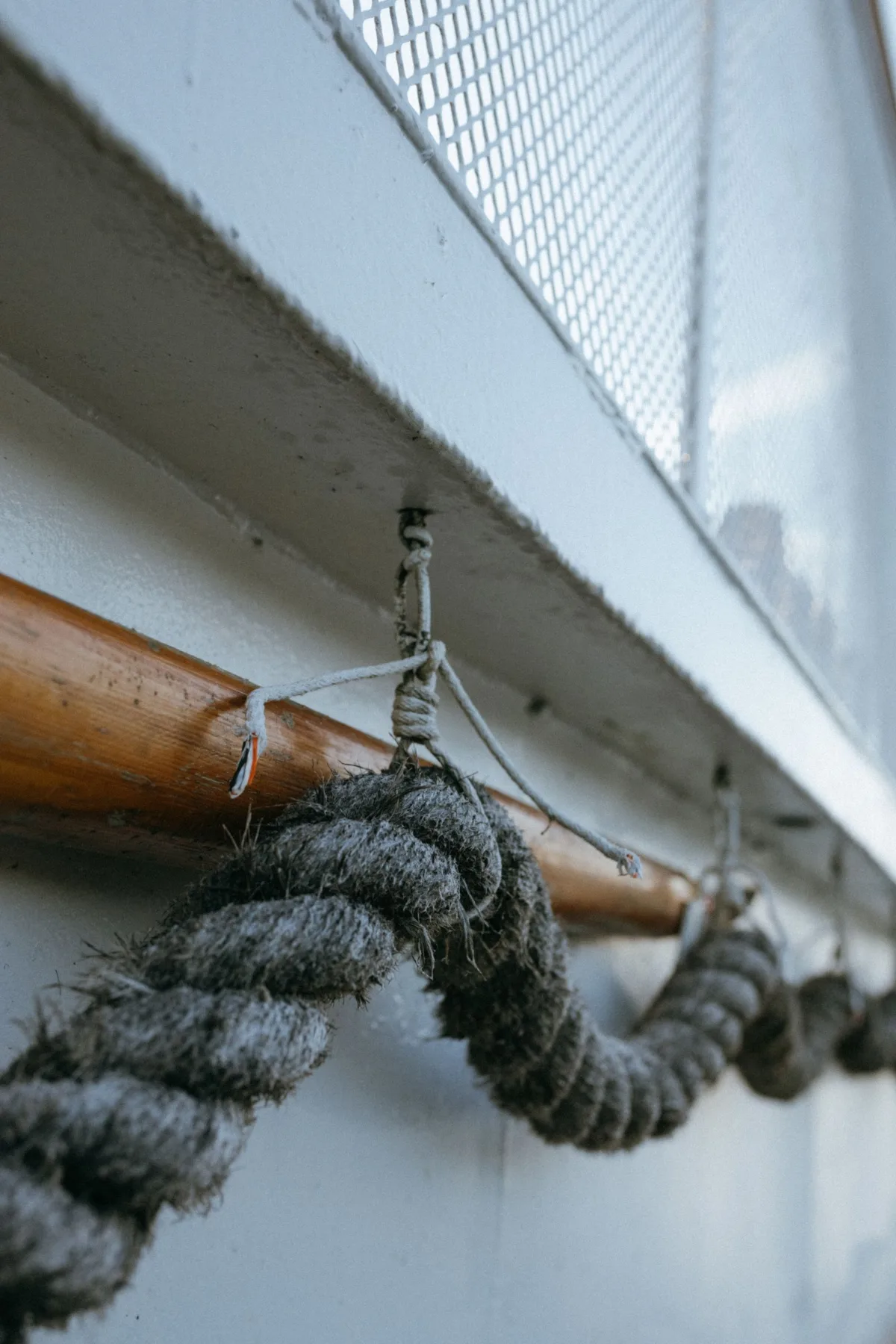
- Side ropes: fraying, cuts, mildew, internal powdering, stiffness, paint or covering, or joints below the top step.
- Steps: splits, loose or tilting steps, worn non-slip surface, cracked or UV-hardened rubber steps.
- Spacing: unequal or outside 300 to 380 mm means steps have slipped.
- Seizings and clamps: loose, corroded or missing.
- Length and stowage: reaches the waterline, stowed dry and clear, securing points sound.
- Repairs: knotted or spliced side ropes, or replacement steps not from the maker.
In Singapore’s heat and humidity, manila degrades fastest where it stays wet in the stowage box, so open the rope lay at the bottom turns during every ladder inspection. As the International Marine Contractors Association (IMCA) warns in its 2021 safety flash on a failed embarkation ladder rope:
Although the surface of the rope may appear to be in satisfactory condition, natural fibre rope may self-abrade from the inside. The lay should be opened at regular intervals along the rope to check for signs of wear.
What Should a Buyer Ask for Before Ordering?
Ask for the type-approval or MED/SOLAS certificate naming the LSA Code and ISO 5489, the length against your freeboard calculation, and the side rope material and circumference. State embarkation ladder or pilot ladder on the purchase order; the certificates are not interchangeable, and neither covers an accommodation ladder. Where a remotely located liferaft needs an alternative means of descent, ask whether a scramble net is accepted by your flag and class rather than assuming it.
Frequently Asked Questions
Is an embarkation ladder the same as a pilot ladder?
No. An embarkation ladder follows LSA Code 6.1.6 for abandoning ship; a pilot ladder follows SOLAS V/23 and MSC.576(110).
What is the step spacing on an embarkation ladder?
Equal spacing of 300 to 380 mm under the LSA Code, against 310 to 350 mm for a pilot ladder.
Does the 36-month replacement rule apply to embarkation ladders?
No. It applies to pilot ladders and manropes under MSC.576(110). Embarkation ladders are replaced on condition.
How often is an embarkation ladder inspected?
Monthly with other life-saving appliances under SOLAS III/20.7, plus at drills and surveys.
Can a rope ladder with knotted ropes be used for survival craft?
Not on ships contracted on or after 1 July 2008, per Lloyd’s Register guidance.
Order the Ladder the Rules Describe
An embarkation ladder is judged when nobody can wait for a replacement. Size it to the waterline at full list, check it monthly against LSA Code 6.1.6, and plan it separately from your 2028 pilot ladder changes. C&C International Trading supplies SOLAS embarkation and pilot ladders in Singapore; send us your freeboard and flag for a quote with certificates.
About the author
Written by the C&C International Trading technical team, reviewed by Denis Koh, Senior Technical Consultant at C&C International Trading. Last updated: November 2026.
Sources: IMO Resolution MSC.576(110); ABS, SOLAS Pilot Transfer Arrangements update; IMPA, June 2025 release; Lloyd’s Register class news; ISO 5489:2024; Canada Life Saving Equipment Regulations, Schedule VI; IMCA Safety Flash 07/21.