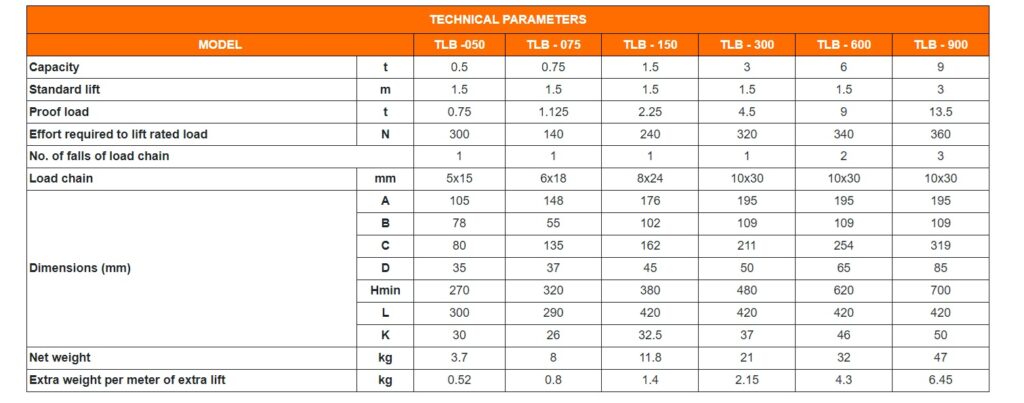
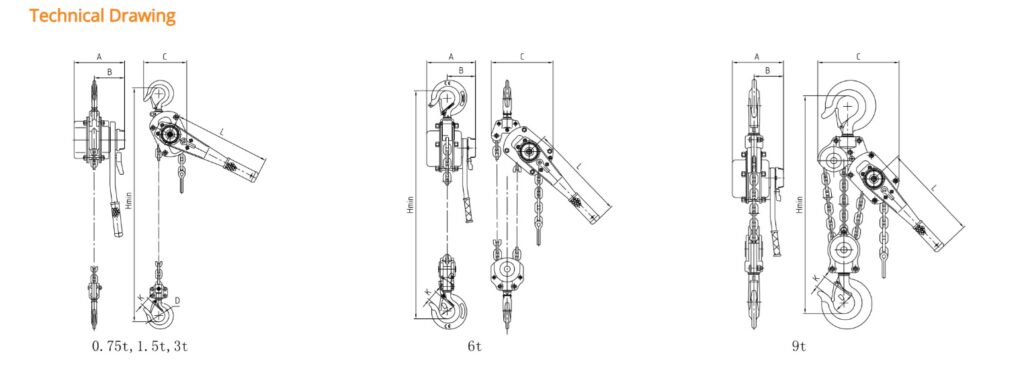
Specifications for common sizes:


Safety
Safety precautions for using lever blocks are critical to preventing equipment failure and serious injury. Key precautions include conducting thorough pre-use inspections, strictly adhering to load limits, and maintaining a straight-line pull during operation.
Pre-Use Inspection Checklist
Never operate a lever block straight out of storage without verifying its condition. At a minimum, check the following:
- Hooks & Latches: Ensure hooks rotate freely and are free from cracks, nicks, or bending. Safety latches must be present and function correctly to prevent load slippage.
- Load Chain: Inspect for twists, kinks, corrosion, or stretching. Each link should be free-moving and properly lubricated.
- Brake System: Verify the internal brake engages and releases smoothly. Conduct a light tension test with a small load to confirm it holds securely.
- Lever & Housing: Check for bent handles, warped casing, or missing bolts. The selector switch should clearly click into “UP,” “DOWN,” and “NEUTRAL” positions.
Critical Operational Precautions
- Adhere to WLL: Never exceed the Working Load Limit (WLL)marked on the hoist’s identification plate.
- Maintain Straight-Line Pull: The chain must remain in a straight line between the anchor point and the load. Side loading or pulling at an angle creates dangerous stress levels and can cause internal binding.
- Avoid “Cheater Bars”: Do not extend the lever handle with a pipe or “cheater bar” to gain more leverage; if the load requires excessive effort, the hoist is likely overloaded or faulty.
- Proper Hooking: Never use the load chain as a sling by wrapping it around the load and hooking back onto the chain. Use appropriately rated lifting slings
Safe Working Environment
- Stand Clear: Position yourself to the side of the pull path to avoid being struck if the load shifts or the chain fails. Never stand directly under a suspended load.
- Controlled Movement: Operate the lever with steady, controlled pumps. Avoid jerky or rapid motions that could introduce shock loads to the system.
- Never Leave Unattended: Do not leave a load suspended while unattended. If an emergency requires you to leave, the area must be cordoned off.
- Environmental Hazards: Avoid exposing the hoist to chemicals, acids, or extreme temperatures (typically outside -40°C to +60°C) unless approved by the manufacturer.